Whoiswho | Allianz Knowledge: "Susy Cheston
Who’s that?
Senior vice-president for policy at Opportunity International
What does she do?
Cheston is a widely consulted expert on microfinance, women’s empowerment, and the reduction of HIV/AIDS. Apart from several published articles about microfinance and interviews on national television and radio, she testified before U.S. Congress in September 2005, urging them to continue to support microfinance as a key development tool.
Cheston joined the U.S.-based Opportunity International in 1991 as a field director in El Salvador. In 1993, she became executive director of the Women’s Opportunity Fund, where she helped develop the “Trust Group” microcredit lending model, which now reaches hundreds of thousands of women in the developing world.
What does she say?
* Microfinance: A Platform for the Empowerment of Women
Craig Churchill
Who’s that?
Microfinance expert at the International Labour Organization (ILO) and chairman of the World Bank's Consultative Group to Assist the Poor (CGAP) Working Group on Microinsurance
What does he do?
In 2001, Craig Churchill joined the Social Finance Program at the International Labor Organization (ILO) where he focuses on how financial services can manage risks and reduce the vulnerability of the poor, for example through providing microinsurance or emergency loans. Churchill also chairs the CGAP Working Group on Microinsurance and serves on the Editorial Board of MicroBanking Bulleting and the Journal of Microfinance. In 2008, Churchill launched the Microinsurance Innovation Facility, a five-year partnership with the Bill and Melinda Gates Foundation, which seeks to spread quality insurance in the developing world’s low income markets to reduce risks and overcome poverty.
Churchill has considerable microfinance experience both in developing and developed countries, with the Get Ahead Foundation, ACCION International, the MicroFinance Network, and Calmeadow. He has authored and edited numerous articles, papers, and training manuals on various microfinance topics. His most recent publication “Protecting the Poor: A Microinsurance Compendium” looks at over 40 organizations that are providing insurance to low-income people, synthesizing lessons from case studies to help practitioners understand how to better provide insurance to low-income markets. Churchill has a BA from Williams College and an MA from Clark University, both in Massachusetts, U.S.
Read more:
* How Microinsurance Serves the Poor
Daryl L. Collins
Who’s that?
Director of The Financial Diaries project
What does she do?
Continuing the work begun by Stuart Rutherford and Orlanda Ruthven, who had examined the financial lives of families in India and Bangladesh, Collins began in 2003 to track how 180 poor households in South Africa managed their money. Collins’s field data from 2003-2005 makes up the biggest set of data in 'The Financial Diaries,” a project that seeks to understand the financial services that poor households use and still need.
Collins is working together with Rutherford and Ruthven, along with Jonathan Morduch and David Hulme, to produce 'The Portfolios of the Poor,' a book that will bring together the Financial Diaries findings from South Africa, India and Bangladesh. It is expected to be published later this year. Collins is currently pursuing doctoral work at New York University.
Read more
* The Financial Diaries
Susan Davis
Who's that?
Chair of the Grameen Foundation and director of the Ashoka Global Academy for Social Entrepreneurship
What does she do?
Davis chairs the board of Grameen Foundation, an internationally focused spin-off of Muhammad Yunus’s Grameen Bank that provides around 3.6 million families in 22 countries with microfinancial services and technology. At Ashoka, Davis has the task of identifying innovative social entrepreneurs to invite into the organization’s growing global network of social entrepreneurs.
Davis is also a senior advisor to the general director of the International Labor Organization, and serves on the boards of BRAC USA, Project Enterprise, Aid to Artisans, Sirleaf Market Women’s Fund, and African Women’s Development Fund USA. Previously, she worked for some of the world’s leading development organizations, including World Women’s Banking and the Ford Foundation in Bangladesh.
What does she say?
* Grameen Bank and Their (Nobel-winning) Approach to Microfinance & Women
Yvo de Boer
Who’s that?
Executive Secretary of the United Nations Framework Convention on Climate Change (UNFCCC)
What does he do?
Yvo de Boer has been actively involved in climate change policies since 1994. The Dutch politician helped shape position of the European Union in the negotiations on the Kyoto Protocol and worked at various UN organizations throughout his career. In August 2006, de Boer, the former director for international affairs of the Dutch environment ministry, was appointed executive secretary of the UNFCCC.
Since his inauguration, the 53-year-old has tried to convince industrialized nations to curb greenhouse gas emissions more vigorously. Environmental groups, however, criticized de Boer for suggesting that rich nations should not be obligated to cut emissions if they paid developing countries to do so on their behalf.
Matthew Flannery
Who’s that?
Co-founder of Kiva.org
What does he do?
Flannery and his wife, Jessica, founded Kiva.org in 2005, which evolved into what Business Week magazine has called the “eBay of microfinance” for its unique peer-to-peer approach to microlending. Anybody with a credit card can use Kiva.org to transfer loans as small as 25 dollars directly to profiled entrepreneurs. So far, over 7 million loans from over 70,000 people have been dispersed through a network of partner microfinance institutions in Africa, Latin America, and Asia.
The idea was born during a trip to Africa in 2004, after which Flannery built a small website featuring pictures and descriptions of entrepreneurs in one Ugandan village who needed some capital to start businesses. He found that friends and family were eager to send loans directly to entrepreneurs in the developing world. (Photo: Brian Oberkirch)
Read more
* Kiva.org - Become a Microlender
Al Gore
Who’s that?
Chairman of the Alliance for Climate Protection, Former U.S. Vice-President, Nobel Peace Prize Laureate
What does he do?
Al Gore is an American politician, businessman, and environmentalist. He gained international recognition as U.S. Vice-President under Bill Clinton. Today he is best known for his role in the fight against climate change. He starred in the award-winning documentary 'An Inconvenient Truth.' One of his many organizations, Save Our Selves, organized the worldwide benefit concert Live Earth to raise awareness about climate change.
Besides his work as an environmentalist, Gore acts as president of the American television channel Current TV, chairman of Generation Investment Management, board member of Apple Inc., and unofficial advisor to Google's senior management.
In December 2007, Gore and the U.N. International Panel on Climate Change received the Nobel Peace Prize for their work to promoting awareness of climate change.
James Hansen
Who’s that?
Director of the NASA Goddard Institute for Space Studies
What does he do?
James Hansen heads the NASA’S Goddard Institute for Space Studies (GISS), one of the foremost research centers on atmospheric and climate changes in the 21st century. Hanson is also an adjunct professor in the Earth and Environmental Sciences department at Columbia University.
Hansen became famous for his testimony on climate change before Congress in the 1980s. He was one of the first to raise broad awareness of the global warming issue.
He is a critic of the Bush administration's stance on climate change. Hansen recently created a stir by claiming that NASA administrators and White House officials edited his statements about the causes of climate change to make global warming seem less threatening.
Before joining NASA in 1962, he studied physics and astronomy in the space science program at the University of Iowa. He holds a Ph.D. in Physics. In 1996, Hansen was elected to the National Academy of Sciences. Among the various honors bestowed upon him are the Heinz Environment Award for his research on global warming and the Dan David Prize.
Steve Howard
Who’s that?
Co-founder and CEO of The Climate Group
What does he do?
In 2003, Howard co-founded The Climate Group, a leading organization that advises government and business on carbon-reduction and climate mitigation strategies. Several large companies (HSBC, Google, British Telecom, British Petroleum, Allianz) and governments (London, New York City, and California) are members of The Climate Group.
As CEO of The Climate Group, Howard has advised and briefed many CEOs and political leaders on climate change. He also chaired a July 2006 climate change meeting with UK Prime Minister Tony Blair, California Governor Arnold Schwarzenegger and several business leaders in California.
Prior to his work at The Climate Group, Howard was director of WWF’s Global Forest and Trade Network, as well as chairman of the UK Forest Stewardship Council and the Tropical Forest Trust.
What does he say?
Suzanne Hunt
Who’s that?
Director of the Worldwatch Institute’s Bioenergy Program
What does she do?
Suzanne Hunt is leading the Bioenergy Program at the Worldwatch Institute, an independent think tank working on environmental, social, and economic issues. Her recent work includes the study, Biofuels for Transportation. Her team assessed the opportunities and risks of large-scale international development of biofuels.
Before joining Worldwatch, she has worked on watershed management planning in New York State, sustainable forestry in Pennsylvania and teaching sakt marsh ecology in South Carolina. She has been a research fellow at Environmental Defense, an environmental non-profit, where she focused on social and environmental safeguard policy reform at the International Finance Institutes.
Hunt is a co- founder of “SmartFuel,” an organization dedicated to teaching children from how to turn waste grease from restaurant kitchens into fuel for their school buses. She is a steering committee member of the “BioEnergy Wiki,' an information sharing hub. She also serves on the board of directors of the “Sustainable Biodiesel Alliance,” as well as the “Renew the Earth” organization.
What does she say?
Evan Mills
Who's that?
Staff scientist at the Lawrence Berkeley National Laboratory
What does he do?
Mills has published important research about the intersection of climate change, energy efficiency, and risk management, including articles for Science and Forbes. Along with several detailed assessments of the global insurance industry’s response to climate change, Mills has also contributed as an author to the influential third and fourth UN Intergovernmental Panel on Climate Change (IPCC) assessments.
Dr. Mills co-authored an article about the legal consequences of global climate change on the insurance industry, which appeared in the Stanford Journal of International Law in the summer of 2007. He is also a member of the Earth Institute's Economics and Public Policy Working Group chaired by Jeffrey Sachs, and heads the Lumina Project, which works to introduce efficient, low-carbon, off-grid white LED lighting in the developing world.
What does he say?
* Are Insurers Getting Serious about Climate Change?
* Who Will Pay for Global Warming?
Nicholas Negroponte
Who’s that?
Chairman of One Laptop per Child, Chairman of the MIT Media Lab
What does he do?
Nicholas Negroponte is an architect and computer scientist best known as the founder and chairman of the Media Lab at the Massachusetts Institute of Technology (MIT).
Negroponte’s current project, One Laptop per Child, aims at providing children around the world, especially those in developing countries, with an inexpensive laptop. Negroponte and former UN General Secretary Kofi Annan unveiled the so-called 100-dollar laptop in 2005. Full-scale production is expected to start in mid-2007. So far, countries scheduled for the pilot roll-out are Argentina, Brazil, Ethiopia, Libya, Nepal, Nigeria, Pakistan, Peru, Romania, Russia, Rwanda, Thailand, Uruguay, and the United States.
Negroponte is also a businessman and writer. In 1992, he became the first investor of the newly created Wired magazine. He later summed up his columns written for Wired in a best-selling book, 'Being Digital,' which outlined his vision of an interactive world.
Rajendra Kumar Pachauri
Who’s that?
Chairman of the UN International Panel on Climate Change
What does he do?
India's Rajendra Kumar Pachauri chairs the Intergovernmental Panel on Climate Change (IPCC) since 2002. The panel recently issued its fourth report, regarded as the most important forecast of global climate change.
After working in the private sector, Pachauri moved to the United States and studied at North Carolina State University. He received Ph.Ds in economics and industrial engineering and served as an assistant professor. Returning to India he joined the Staff College of India, Hyderabad. Since 1981 he has headed the Tata Energy Research Institute (TERI), a think tank focused on energy, environment, forestry, biotechnology, and the conservation of natural resources.
Pachauri also serves as the head of The Energy and Resources Institute, a developing-country institution devoted to sustainable development. The United Nations Development Programme appointed him as a part time advisor in the fields of energy and sustainable management of natural resources from 1994 to 1999. He is advisor and member of a number of organizations and research institutes, and has authored 21 books and numerous papers and articles.
In acknowledgement of his environmental contributions, Pachauri was awarded the Padma Bhushan - one of India's highest civilian awards that recognizes distinguished service to the nation - in 2001. In December 2007, the IPCC and Al Gore were awarded the Nobel Peace Prize.
Read more
* The UN Global Warming Report
Facts and Predictions
* The Political Heat Is On - First Part of UN Climate Change Report
Jonathan Patz
Who’s that?
Associate Professor of Environmental Studies and Population Health Sciences, University of Wisconsin-Madison
What does he do?
Dr. Patz is one of the world’s leading authorities on the human health risks of climate change. He directs the Center for Sustainability and the Global Environment (SAGE) at the University of Wisconsin. He is also lead author of the United Nations/World Bank Millennium Ecosystem Assessment, as well as several World Health Organization (WHO) and Intergovernmental Panel on Climate Change (IPCC) reports about the health impacts of global environmental change.
Since the early 1990s, he has lectured and published important scientific papers about how climate change and deforestation could increase heat-stress, malaria incidence, and the spread of other diseases. He co-edits the journal, Ecohealth: Conservation Medicine and Ecosystem Sustainability.
What does he say?
* How Hot is Too Hot? The Health Risks of Climate Change for All of Us
Bibi Russell
Who’s that?
Founder of Bibi Productions: Fashion for Development
What does she do?
Bibi Russell’s work and business is focused on improving the economic conditions of the some 35,000 weavers, designers and artisans in her native Bangladesh who have worked for her company, Bibi Productions. She has also worked with Muhammad Yunus’s Grameen Bank, particularly its Grameen Uddog handloom enterprise in Bangladesh.
Since the 1970s, Russell has tried to show the beautiful side of Bangladesh. As a model, she has appeared in top magazines, including Vogue, Cosmopolitan, and Harper’s Bazaar. From the mid-1990s, Russell launched successful international shows and fashion lines abroad showcasing Bangladeshi craftsmanship and local textile manufacturing. In 1998, after heavy flooding in Bangladesh had made millions of people homeless and destroyed much of the country's silk and weaving industry, she founded the charity “Save the Weavers” to help rebuild the industry.
Russell was voted “Woman of the Year” by Elle magazine in 1997, and since 1999, has enjoyed two prestigious titles – Honorary Fellow of the London Institute and the UNESCO Special Envoy: Designer for Development.
* Road Transport: The Science of Safety
Jeffrey Sachs
Who's that?
Director of The Earth Institute at Columbia University
What does he do?
Sachs has become perhaps the world's best-known economist for his work on poverty and disease reduction in the developing world. Along with his duties as Quetelet Professor of Sustainable Development and Professor of Health Policy and Management at Columbia University, Sachs also directs The Earth Institute, which focuses the sustainability research carried out throughout the university. Sachs is also co-founder of Millennium Promise - a non-profit aimed at acheiving the Millennium Development Goals in Africa - as well as a special advisor to United Nations Secretary General Ban Ki-moon.
As an economics professor at Harvard University during the 1990s, Sachs helped find solutions to economic crises in various countries, most notably in Poland, Russia, and Bolivia. Since then, his work has become increasingly focused on addressing persistant poverty, hunger, and disease in the developing world, and finding an environmentally sustainable form of economic development. He advised former UN Secretary General Kofi Annan on the Millennium Development Goals, and has been a key figure in establishing the Millennium Villages, a group of nearly 80 villages across Africa where promising development and disease control measures are being be tested.
Sachs's bestselling book, 'The End of Poverty' (2005), highlights some of the economic lessons learned from his work on various continents.
Read more
* The Earth Institute at Columbia University
* Two Steps Forward, One Step Back: Halfway towards the UN Millennium Development Goals
Hans Joachim Schellnhuber
Who’s that?
Founder and director of the Potsdam Institute of Climate Impact Research
What does he do?
Hans Joachim Schellnhuber is a leading scientist on climate change and an advisor to German Chancellor Angela Merkel.
In 1991, he became founding director of the Potsdam Institute for Climate Impact Research (PIK), establishing the institution as one of Germany’s leading research centers on climate change. From 2001 to 2005 he also acted as a research director at the Tyndall Centre for Climate Change Research.
Schellnhuber is advisor and member of a number of national and international panels on environment and development matters. Among others, he contributed to the UN’s Climate Change Reports in the International Panel on Climate Change (IPCC). His work at the Tyndall Centre also earned him the title of a Commander of the Order of the British Empire awarded by Queen Elizabeth II. He is an elected member of the Max Planck Society, the U.S. National Academy of Sciences, the Leibniz-Sozietät, the Geological Society of London, and the International Research Society Sigma Xi, among others.
He has written over 190 articles and about 40 books in the fields of condensed matter physics, complex systems dynamics, climate change research, Earth system analysis, and sustainability science.
What does he say?
* 'We are facing a third industrial revolution'
Andrew L. Shapiro
Who’s that?
Founder and CEO of GreenOrder
What does he do?
Andrew L. Shapiro is a writer, lawyer, and consultant interested in the impact of new technologies such as the Internet. His book, 'The Control Revolution,' talks about how technology changes society. In 2000, he founded the strategy and marketing firm GreenOrder that aims to turn sustainability into a source of business value.
Prior to his work at GreenOrder, Shapiro was senior advisor to the Markle Foundation and a lecturer at Columbia Law School. He served as director of the Aspen Institute Internet Policy Project and is a fellow of Harvard Law School's Berkman Center for Internet & Society. He is a co-founder of the Technorealism project, which raises public awareness about the impact of technology.
What does he say?
Nicholas Stern
Who’s that?
Lead author of the Stern Review on the Economics of Climate Change
What does he do?
Sir Nicholas Stern is a British economist and academic. After serving as the chief economist and senior vice-president of the World Bank, he is now a civil servant and government economic advisor in the United Kingdom.
Due to his background in economic development and growth, Stern was appointed to conduct reviews on the economics of climate change in 2005. This culminated in the publication of the so-called Stern Review in October 2006.
The study gained global media attention for its thesis that climate change is an enormous market failure which will cause tremendous costs if left unattended. Stern called for policies that would enable market forces to develop low-carbon technologies to stop or at least mitigate climate change. The resulting costs, although in the billions, would be far below the costs of likely climate change impacts.
Stern holds a degree in mathematics and gained a Ph.D in economics. He has lectured at Cambridge University, the University of Warwick, and the London School of Economics. His research focused on economic development and growth, and he also wrote books on Kenya and the Green Revolution in India.
Read more
* United Kingdom Climate Change Profile
Part 1: A New Industrial Revolution?
* Trade or Tax? How to Get Rid of Greenhouse Gases
Björn Stigson
Who’s that?
President of the World Business Council for Sustainable Development
What does he do?
The WBCSD is a coalition of around 200 corporations that share ideas and techniques on sustainable development. As president, Stigson emphasizes that sustainable development relies on three pillars: economic growth, ecological balance, and social progress.
Prior to taking his position at WBCSD in 1995, Stigson worked as a financial analyst at various international companies, both in his native Sweden and abroad. Presently, Stigson serves as an advisor to the Chinese government, the Dow Jones Sustainability Index, the Clinton Global Initiative, and the Dean’s Council of the Kennedy School of Government at Harvard University. He is also a member of the board of the Global Reporting Initiative and the International Risk Governance Council. In 2007, Stigson was ranked 9th among the '100 Most Influential People in Business' Ethics by Ethisphere Magazine.
Read more
> http://www.wbcsd.org
David Suzuki
Who’s that?
Award-winning scientist, environmental activist, and board member of the David Suzuki Foundation
What does he do?
For over 30 years, Canadian scientist David Suzuki has received many awards for explaining the complexities of environmental science and genetics in a compelling, easily understandable way.
In 1990, he established the David Suzuki Foundation, an independent charity to promote resource conservation and environmental protection. Suzuki is renowned speaker about climate change, clean energy, and sustainability.
Since the 1970s, Suzuki had been outspoken about climate change, describing it as a very real and pressing problem, and openly criticizing governments for their lack of action to protect the environment.
Suzuki has published more than 40 books about science and environmental issues and has written, produced, and hosted several television and radio programs in Canada. He holds a biology degree from Amherst University and a doctorate in zoology from the University in Chicago. He has also received twenty honorary degrees from universities in the United States, Canada, and Australia.
Michael P. Totten
Who’s that?
Senior Director at the Center for Environmental Leadership in Business (CELB)
What does he do?
At CELB, a branch of Conservation International, Totten advises businesses in the United States and abroad about the ecological and economic opportunities of energy efficiency, sustainability and climate-friendly investment.
Totten was advising the U.S. government about global warming long before the issue was grabbing headlines. During the 1980s, Totten was an instrumental figure in the drafting of the Global Warming Prevention Act of 1989.
He also served as co-director of the World Resources Institute's Management Institute for Environment and Business and executive director of the Center for Renewable Energy and Sustainable Technology, which has since become one of the most-consulted sources on sustainable development on the Internet.
Muhammad Yunus
Who’s that?
Founder of Grameen Bank, Nobel Prize Laureate
What does he do?
Muhammad Yunus is a Bangladeshi banker and economist. Trained as an economist in Bangladesh and later in the United States, Yunus returned to Bangladesh after the country became independent in 1971 to help with nation-building. He later lectured as an professor of economics, until he decided apply the concept of microcredit into practical life to protect small entrepreneurs from predatory lending.
In 1974, he gave out 27 dollars worth of loans to women in a village next to his university. After building on the initial success of these loans, he founded Grameen Bank in 1976, and the bank became an independent entity 1983. Despite setbacks, the bank grew throughout Bangladesh and has spawned many similar microcredit initiatives internationally.
In 2006, Yunus and Grameen Bank were jointly awarded the Nobel Peace Prize 'for their efforts to create economic and social development from below.' Yunus received numerous other honors, including the ITU World Information Society Award, Ramon Magsaysay Award, the World Food Prize and the Sydney Peace Prize. He is the author of 'Banker to the Poor' and a founding board member of Grameen Foundation.
Read more
* What the Poor Really Need
* Grameen Bank and Their (Nobel-winning) Approach to Microfinance & Women"
Sunday, May 17, 2009


Whoiswho | Allianz Knowledge
Whoiswho | Allianz Knowledge:
"Asit K. Biswas
Who’s that?
President of the Third World Center for Water Management
What does he do?
Asit K. Biswas was born in India and lives in Mexico where he heads the Third World Institute for Water Management, an independent think tank focusing on knowledge generation, synthesis, application, and dissemination.
Biswas is the founder of the 'International Journal of Water Resources Development,' and has been its editor-in-chief for the past 21 years. He written or edited 64 books and published over 600 scientific and technical papers.
Biswas studied at the Indian Institute of Technology in Kharagpur. He has lectured at Queen´s University in Kingston, Canada, before joining the Canadian Ministry of Environment. He later helped establish the United Nations Environment Programme (UNEP) in Nairobi, Kenya and acted as senior scientific advisor to the executive director of UNEP and chaired the Middle East Water Commission.
Among his numerous prizes are the two highest awards of the International Water Resources Association (Crystal Drop and Millennium Award), Walter Huber Award of the American Society of Civil Engineering, and Honorary Degree of Doctor of Technology of the University of Lund in Sweden.
Read more
* Is the Blue Planet Running Dry?"
"Asit K. Biswas
Who’s that?
President of the Third World Center for Water Management
What does he do?
Asit K. Biswas was born in India and lives in Mexico where he heads the Third World Institute for Water Management, an independent think tank focusing on knowledge generation, synthesis, application, and dissemination.
Biswas is the founder of the 'International Journal of Water Resources Development,' and has been its editor-in-chief for the past 21 years. He written or edited 64 books and published over 600 scientific and technical papers.
Biswas studied at the Indian Institute of Technology in Kharagpur. He has lectured at Queen´s University in Kingston, Canada, before joining the Canadian Ministry of Environment. He later helped establish the United Nations Environment Programme (UNEP) in Nairobi, Kenya and acted as senior scientific advisor to the executive director of UNEP and chaired the Middle East Water Commission.
Among his numerous prizes are the two highest awards of the International Water Resources Association (Crystal Drop and Millennium Award), Walter Huber Award of the American Society of Civil Engineering, and Honorary Degree of Doctor of Technology of the University of Lund in Sweden.
Read more
* Is the Blue Planet Running Dry?"
Whoiswho | Allianz Knowledge
Whoiswho | Allianz Knowledge: "Christina Barrineau
Who’s that?
Managing director of the Financial Access Initiative
What does she do?
Barrineau is managing director of the Financial Access Initiative, a joint project of Harvard, Yale and New York University that focuses research about improving access to financial services to the world’s poor.
Prior to this position, Barrineau was senior technical advisor for the United Nations International Year of Microcredit in 2005, a pivotal year for generating awareness internationally about the potential of microfinance. With the collaboration of several UN agencies and high-profile sponsors and partners, the Year helped transform microfinance from “something cute” (in the public eye) into something discussed seriously in corporate boardrooms and international meetings of the International Monetary Fund."
Who’s that?
Managing director of the Financial Access Initiative
What does she do?
Barrineau is managing director of the Financial Access Initiative, a joint project of Harvard, Yale and New York University that focuses research about improving access to financial services to the world’s poor.
Prior to this position, Barrineau was senior technical advisor for the United Nations International Year of Microcredit in 2005, a pivotal year for generating awareness internationally about the potential of microfinance. With the collaboration of several UN agencies and high-profile sponsors and partners, the Year helped transform microfinance from “something cute” (in the public eye) into something discussed seriously in corporate boardrooms and international meetings of the International Monetary Fund."
Whoiswho | Allianz Knowledge
Whoiswho | Allianz Knowledge:
"Climate expert Christoph Bals is the policy director of Germanwatch, an independent, non-profit, and non-governmental organization based in Germany. Since 1991, Germanwatch has tackled issues such as food and trade security, climate change, and North-South relations. In 2005, Bals launched the service “atmosfair” that neutralizes air travel emissions through climate protection projects. He was also one of the founders of the European Business Council for Sustainable Energy and the e-mission 55 business campaign. In Bals’ opinion, the targets of the Kyoto Protocol are far too low. He also repeatedly called for tougher U.S. standards on greenhouse gas emissions.
Bals holds a degree in theology, philosophy, and economics. In 2007, he was awarded with the German Journalism Prize 2008 for his paper “The dark side of biofuel”.
Read more:
* Germany Climate Change Profile
Part 6: G8 Signal Has to Be “Loud, Long and Legal”
* Germanwatch"
"Climate expert Christoph Bals is the policy director of Germanwatch, an independent, non-profit, and non-governmental organization based in Germany. Since 1991, Germanwatch has tackled issues such as food and trade security, climate change, and North-South relations. In 2005, Bals launched the service “atmosfair” that neutralizes air travel emissions through climate protection projects. He was also one of the founders of the European Business Council for Sustainable Energy and the e-mission 55 business campaign. In Bals’ opinion, the targets of the Kyoto Protocol are far too low. He also repeatedly called for tougher U.S. standards on greenhouse gas emissions.
Bals holds a degree in theology, philosophy, and economics. In 2007, he was awarded with the German Journalism Prize 2008 for his paper “The dark side of biofuel”.
Read more:
* Germany Climate Change Profile
Part 6: G8 Signal Has to Be “Loud, Long and Legal”
* Germanwatch"
Whoiswho | Allianz Knowledge
Whoiswho | Allianz Knowledge:
"As head of the Citigroup Microfinance Group, Bob Annibale leads Citigroup’s relationships with microfinance institutions as commercial partners and clients, providing financing and product partnerships. Annibale’s aim is to make microcredit accessible to the majority of the population in many countries, including the poor and those without bank accounts, to encourage economic development among the world's poorest communities.
Annibale represents Citigroup on the Board of the Microfinance Information Exchange, the Council of Microfinance Equity Funds, and serves on several external boards and councils, including the Board of Advisors for the United Nations High Level Commission on Legal Empowerment of the Poor, the University of London. He was previously a member of the UK Government's Foreign and Commonwealth Office Africa Policy Group.
Annibale joined Citibank in 1982 and held various senior treasury, risk and corporate positions. He holds a BA degree in History and Political Science from Vassar College and a graduate degree in African History from the University of London."
"As head of the Citigroup Microfinance Group, Bob Annibale leads Citigroup’s relationships with microfinance institutions as commercial partners and clients, providing financing and product partnerships. Annibale’s aim is to make microcredit accessible to the majority of the population in many countries, including the poor and those without bank accounts, to encourage economic development among the world's poorest communities.
Annibale represents Citigroup on the Board of the Microfinance Information Exchange, the Council of Microfinance Equity Funds, and serves on several external boards and councils, including the Board of Advisors for the United Nations High Level Commission on Legal Empowerment of the Poor, the University of London. He was previously a member of the UK Government's Foreign and Commonwealth Office Africa Policy Group.
Annibale joined Citibank in 1982 and held various senior treasury, risk and corporate positions. He holds a BA degree in History and Political Science from Vassar College and a graduate degree in African History from the University of London."
Microinsurance Profile India - Protecting The Poor | Microinsurance | Allianz Knowledge
Microinsurance Profile India - Protecting The Poor | Microinsurance | Allianz Knowledge: "Microinsurance Profile India - Protecting the Poor
By mid-century, India will be the world’s most populated nation, but also home to more poor people than any other country. A crucial asset in the fight against poverty could be microinsurance that covers the poor against disease, accidents and natural disasters."
By mid-century, India will be the world’s most populated nation, but also home to more poor people than any other country. A crucial asset in the fight against poverty could be microinsurance that covers the poor against disease, accidents and natural disasters."
Microfinance Special | Special | Allianz Knowledge
Microfinance Special | Special | Allianz Knowledge: "Financial Services for the 'Not-Bankable'
Microfinance links longterm development targets and economic thinking. Financial tools - such as small loans, affordable savings accounts and low-premium insurance policies - help poor households and small businesses that do not typically have access to financial services."
Microfinance links longterm development targets and economic thinking. Financial tools - such as small loans, affordable savings accounts and low-premium insurance policies - help poor households and small businesses that do not typically have access to financial services."
SEC Info - “ Manuel V. Pangilinan ” - Filings - p. 1
SEC Info - “ Manuel V. Pangilinan ” - Filings - p. 1:
"Manuel V. Pangilinan”
Filings as: Signatory
7 Filings · Documents containing “Manuel and V and Pangilinan” with Text matching “Manuel or V near Pangilinan” anywhere in Selected Filings
Page: 1 2 3 · All · Bottom
in Show and
Help... Wildcards: ? (any letter), * (many). Logic: for Docs: & (and), | (or); for Text: | (anywhere), '(&)' (near).
As Of Filer Doc Filing¹ As/For/On Docs:Pgs Issuer Agent
Sort in ascending order Sort in ascending order Sort in ascending order Sort in descending order Sort in ascending order Sort in ascending order
2/09/06 First Pacific Company Ltd/FI SC 13D/A 3:72 Philippine Long Distance Tele..Co RR Donnelley/FA
Enterprise Investments Holdings/Inc²
Holland Pacific N/V²
Intalink B/V²
Larouge B/V²
Metro Pacific Assets Holdings/Inc²
Metro Pacific Holdings/Inc²
Metro Pacific Investments Limited²
Metro Pacific Resources/Inc²
Osbert Limited²
Philippine Telecommunications Investment Corporation²
Semilion Enterprises Inc²
1: SC 13D/A............ Amendment No. 12 to Schedule 13d -- HTML
SC 13D/A · 1st Page of 37± No Page-Breaks
Line 1,876: ... /s/ Manuel V. Pangilinan Name: Manuel V. Pangilinan
Line 1,891: ... /s/ Manuel V. Pangilinan Name: Manuel V. Pangilinan
Line 1,906: ... /s/ Manuel V. Pangilinan Name: Manuel V. Pangilinan
Line 1,921: ... /s/ Manuel V. Pangilinan Name: Manuel V. Pangilinan
Line 1,942: ... /s/ Manuel V. Pangilinan Name: Manuel V. Pangilinan
Line 1,957: ... /s/ Manuel V. Pangilinan Name: Manuel V. Pangilinan
Line 1,972: ... /s/ Manuel V. Pangilinan Name: Manuel V. Pangilinan
Line 1,987: ... /s/ Manuel V. Pangilinan Name: Manuel V. Pangilinan
Line 2,002: ... /s/ Manuel V. Pangilinan Name: Manuel V. Pangilinan
Line 2,023: ... /s/ Manuel V. Pangilinan Name: Manuel V. Pangilinan
Line 2,038: ... /s/ Manuel V. Pangilinan Name: Manuel V. Pangilinan
2: EX-99.1............. Joint Filing Agreement Dated February 9,
2006 -- HTML
EX-99.1 · 1st Page of 2± No Page-Breaks
Line 54: ... /s/ Manuel V. Pangilinan Name: Manuel V. Pangilinan Title: Director
Line 67: ... /s/ Manuel V. Pangilinan Name: Manuel V. Pangilinan Title: Managing Director
Line 80: ... /s/ Manuel V. Pangilinan Name: Manuel V. Pangilinan Title: Managing Director
Line 93: ... /s/ Manuel V. Pangilinan Name: Manuel V. Pangilinan Title: Managing Director
Line 112: ... /s/ Manuel V. Pangilinan Name: Manuel V. Pangilinan Title: Director
Line 125: ... /s/ Manuel V. Pangilinan Name: Manuel V. Pangilinan Title: Director
Line 138: ... /s/ Manuel V. Pangilinan Name: Manuel V. Pangilinan Title: Director
Line 151: ... /s/ Manuel V. Pangilinan Name: Manuel V. Pangilinan Title: Director
Line 164: ... /s/ Manuel V. Pangilinan Name: Manuel V. Pangilinan Title: Director
Line 185: ... /s/ Manuel V. Pangilinan Name: Manuel V. Pangilinan
Line 206: ... /s/ Manuel V. Pangilinan Name: Manuel V. Pangilinan
3: EX-99.52............ Co-Operation Agreement Dated January 31,
2006 -- HTML
1/13/06 First Pacific Company Ltd/FI SC 13D/A 8:104 Philippine Long Distance Tele..Co RR Donnelley/FA
Enterprise Investments Holdings/Inc²
Holland Pacific N/V²
Intalink B/V²
Larouge B/V²
Metro Pacific Assets Holdings/Inc²
Metro Pacific Holdings/Inc²
Metro Pacific Investments Limited²
Find Words in Filings - “Manuel V. Pangilinan” - p. 1
Page 1’s 1 filing (of 7 in this set) was scanned for every hit.
3 documents within the filing were searched.
2 docs contained the words “Manuel and V and Pangilinan”.
Each doc matched “Manuel or V near Pangilinan” anywhere.
132 individual “word” matches are highlighted above.
End “Find Words in Filings” and just List the Filings"
"Manuel V. Pangilinan”
Filings as: Signatory
7 Filings · Documents containing “Manuel and V and Pangilinan” with Text matching “Manuel or V near Pangilinan” anywhere in Selected Filings
Page: 1 2 3 · All · Bottom
in Show and
Help... Wildcards: ? (any letter), * (many). Logic: for Docs: & (and), | (or); for Text: | (anywhere), '(&)' (near).
As Of Filer Doc Filing¹ As/For/On Docs:Pgs Issuer Agent
Sort in ascending order Sort in ascending order Sort in ascending order Sort in descending order Sort in ascending order Sort in ascending order
2/09/06 First Pacific Company Ltd/FI SC 13D/A 3:72 Philippine Long Distance Tele..Co RR Donnelley/FA
Enterprise Investments Holdings/Inc²
Holland Pacific N/V²
Intalink B/V²
Larouge B/V²
Metro Pacific Assets Holdings/Inc²
Metro Pacific Holdings/Inc²
Metro Pacific Investments Limited²
Metro Pacific Resources/Inc²
Osbert Limited²
Philippine Telecommunications Investment Corporation²
Semilion Enterprises Inc²
1: SC 13D/A............ Amendment No. 12 to Schedule 13d -- HTML
SC 13D/A · 1st Page of 37± No Page-Breaks
Line 1,876: ... /s/ Manuel V. Pangilinan Name: Manuel V. Pangilinan
Line 1,891: ... /s/ Manuel V. Pangilinan Name: Manuel V. Pangilinan
Line 1,906: ... /s/ Manuel V. Pangilinan Name: Manuel V. Pangilinan
Line 1,921: ... /s/ Manuel V. Pangilinan Name: Manuel V. Pangilinan
Line 1,942: ... /s/ Manuel V. Pangilinan Name: Manuel V. Pangilinan
Line 1,957: ... /s/ Manuel V. Pangilinan Name: Manuel V. Pangilinan
Line 1,972: ... /s/ Manuel V. Pangilinan Name: Manuel V. Pangilinan
Line 1,987: ... /s/ Manuel V. Pangilinan Name: Manuel V. Pangilinan
Line 2,002: ... /s/ Manuel V. Pangilinan Name: Manuel V. Pangilinan
Line 2,023: ... /s/ Manuel V. Pangilinan Name: Manuel V. Pangilinan
Line 2,038: ... /s/ Manuel V. Pangilinan Name: Manuel V. Pangilinan
2: EX-99.1............. Joint Filing Agreement Dated February 9,
2006 -- HTML
EX-99.1 · 1st Page of 2± No Page-Breaks
Line 54: ... /s/ Manuel V. Pangilinan Name: Manuel V. Pangilinan Title: Director
Line 67: ... /s/ Manuel V. Pangilinan Name: Manuel V. Pangilinan Title: Managing Director
Line 80: ... /s/ Manuel V. Pangilinan Name: Manuel V. Pangilinan Title: Managing Director
Line 93: ... /s/ Manuel V. Pangilinan Name: Manuel V. Pangilinan Title: Managing Director
Line 112: ... /s/ Manuel V. Pangilinan Name: Manuel V. Pangilinan Title: Director
Line 125: ... /s/ Manuel V. Pangilinan Name: Manuel V. Pangilinan Title: Director
Line 138: ... /s/ Manuel V. Pangilinan Name: Manuel V. Pangilinan Title: Director
Line 151: ... /s/ Manuel V. Pangilinan Name: Manuel V. Pangilinan Title: Director
Line 164: ... /s/ Manuel V. Pangilinan Name: Manuel V. Pangilinan Title: Director
Line 185: ... /s/ Manuel V. Pangilinan Name: Manuel V. Pangilinan
Line 206: ... /s/ Manuel V. Pangilinan Name: Manuel V. Pangilinan
3: EX-99.52............ Co-Operation Agreement Dated January 31,
2006 -- HTML
1/13/06 First Pacific Company Ltd/FI SC 13D/A 8:104 Philippine Long Distance Tele..Co RR Donnelley/FA
Enterprise Investments Holdings/Inc²
Holland Pacific N/V²
Intalink B/V²
Larouge B/V²
Metro Pacific Assets Holdings/Inc²
Metro Pacific Holdings/Inc²
Metro Pacific Investments Limited²
Find Words in Filings - “Manuel V. Pangilinan” - p. 1
Page 1’s 1 filing (of 7 in this set) was scanned for every hit.
3 documents within the filing were searched.
2 docs contained the words “Manuel and V and Pangilinan”.
Each doc matched “Manuel or V near Pangilinan” anywhere.
132 individual “word” matches are highlighted above.
End “Find Words in Filings” and just List the Filings"
SEC Info - Philippine Long Distance Telephone Co - 6-K - For 5/15/09
SEC Info - Philippine Long Distance Telephone Co - 6-K - For 5/15/09: "Report of a Foreign Private Issuer · Form 6-K
Filing Table of Contents
Document/Exhibit Description Pages Size
1: 6-K Live Filing HTML 10K
2: EX-99 Miscellaneous Exhibit HTML 18K
6-K · Live Filing
This is an EDGAR HTML document rendered as filed. [ Alternative Formats ]
Sponsored Ads...
Philippine Long Distance Telephone Company - Form 6-K
UNITED STATES
SECURITIES AND EXCHANGE COMMISSION
Washington, D.C. 20549
Form 6-K
REPORT OF FOREIGN PRIVATE ISSUER
PURSUANT TO RULE 13a-16 OR 15d-16
UNDER THE SECURITIES EXCHANGE ACT OF 1934
May 15, 2009
Philippine Long Distance Telephone Company
———————————————————————————————————
(Translation of registrant’s name into English)
Ramon Cojuangco Building
Makati Avenue, Makati City
Philippines
———————————————————————————————————
(Address of principal executive office)
Indicate by check mark whether the registrant files or will file annual reports under cover of Form 20-F or Form 40-F: [x] Form 20-F [ ] Form 40-F
Indicate by check mark if the registrant is submitting the Form 6-K in paper as permitted by Regulation S-T Rule 101(b)(1): [ ]
Indicate by check mark if the registrant is submitting the Form 6-K in paper as permitted by Regulation S-T Rule 101(b)(7): [ ]
Indicate by check mark whether the registrant by furnishing the information contained in this Form is also thereby furnishing the information to the Commission pursuant to Rule 12g3-2(b) under the Securities Exchange Act of 1934: [ ] Yes [x] No
If 'Yes' is marked, indicate below the file number assigned to the registrant in connection with Rule 12g3-2(b): n/a
Disclosure sent to PSE and SEC re: transaction entered into by Smart
Communications, Inc.
SIGNATURES
Pursuant to the requirements of the Securities Exchange Act of 1934, the registrant has duly caused this report to be signed on its behalf by the undersigned, thereunto duly authorized.
Philippine Long Distance Telephone Company
Date: 05/15/2009 By: Ma. Lourdes C. Rausa-Chan
Name: Ma. Lourdes C. Rausa-Chan
Title: SVP and Corporate Secretary
EXHIBIT INDEX
Exhibit No. Description
99 Copy of the disclosure letter we sent to the Philippine Stock Exchange and the Securities and Exchange Commission regarding a transaction entered into by Smart Communications, Inc., our wholly owned subsidiary."
Filing Table of Contents
Document/Exhibit Description Pages Size
1: 6-K Live Filing HTML 10K
2: EX-99 Miscellaneous Exhibit HTML 18K
6-K · Live Filing
This is an EDGAR HTML document rendered as filed. [ Alternative Formats ]
Sponsored Ads...
Philippine Long Distance Telephone Company - Form 6-K
UNITED STATES
SECURITIES AND EXCHANGE COMMISSION
Washington, D.C. 20549
Form 6-K
REPORT OF FOREIGN PRIVATE ISSUER
PURSUANT TO RULE 13a-16 OR 15d-16
UNDER THE SECURITIES EXCHANGE ACT OF 1934
May 15, 2009
Philippine Long Distance Telephone Company
———————————————————————————————————
(Translation of registrant’s name into English)
Ramon Cojuangco Building
Makati Avenue, Makati City
Philippines
———————————————————————————————————
(Address of principal executive office)
Indicate by check mark whether the registrant files or will file annual reports under cover of Form 20-F or Form 40-F: [x] Form 20-F [ ] Form 40-F
Indicate by check mark if the registrant is submitting the Form 6-K in paper as permitted by Regulation S-T Rule 101(b)(1): [ ]
Indicate by check mark if the registrant is submitting the Form 6-K in paper as permitted by Regulation S-T Rule 101(b)(7): [ ]
Indicate by check mark whether the registrant by furnishing the information contained in this Form is also thereby furnishing the information to the Commission pursuant to Rule 12g3-2(b) under the Securities Exchange Act of 1934: [ ] Yes [x] No
If 'Yes' is marked, indicate below the file number assigned to the registrant in connection with Rule 12g3-2(b): n/a
Disclosure sent to PSE and SEC re: transaction entered into by Smart
Communications, Inc.
SIGNATURES
Pursuant to the requirements of the Securities Exchange Act of 1934, the registrant has duly caused this report to be signed on its behalf by the undersigned, thereunto duly authorized.
Philippine Long Distance Telephone Company
Date: 05/15/2009 By: Ma. Lourdes C. Rausa-Chan
Name: Ma. Lourdes C. Rausa-Chan
Title: SVP and Corporate Secretary
EXHIBIT INDEX
Exhibit No. Description
99 Copy of the disclosure letter we sent to the Philippine Stock Exchange and the Securities and Exchange Commission regarding a transaction entered into by Smart Communications, Inc., our wholly owned subsidiary."
SEC Info - Philippine Long Distance Telephone Co - 424B3 - On 11/23/05
SEC Info - Philippine Long Distance Telephone Co - 424B3 - On 11/23/05
AMERICAN DEPOSITARY RECEIPT
Prospectus · Rule 424(b)(3) --- S.E.C. (U.S.A.)
AMERICAN DEPOSITARY RECEIPT
Prospectus · Rule 424(b)(3) --- S.E.C. (U.S.A.)
Saturday, May 16, 2009
Banking Software - Launching of Micro Finance Solution
Banking Software - Launching of Micro Finance Solution: "Probanx is launching Micro Finance Banking Software
Probanx is proud to announce lunching new banking solution for small credit unions, rural and community banks based in Africa and in the Caribbean.
MFS is derived from CorePlus, a multi-currency multi-lingual banking solution, which has been adopted by the banks on three continents so far. The system is built on a modular principle and therefore gives us a flexibility to tailor it to specific needs of any microfinance and NGO organizations.
MFS is easy to install and maintain. The maintenance is provided according to the communication channels available by a particular client.
MFS is a cost effective solution based on the latest scalable technology. As your organization grows, you may order additional modules which will be seamlessly integrated with your existing system."
Probanx is proud to announce lunching new banking solution for small credit unions, rural and community banks based in Africa and in the Caribbean.
MFS is derived from CorePlus, a multi-currency multi-lingual banking solution, which has been adopted by the banks on three continents so far. The system is built on a modular principle and therefore gives us a flexibility to tailor it to specific needs of any microfinance and NGO organizations.
MFS is easy to install and maintain. The maintenance is provided according to the communication channels available by a particular client.
MFS is a cost effective solution based on the latest scalable technology. As your organization grows, you may order additional modules which will be seamlessly integrated with your existing system."
United Nations Capital Development Fund
United Nations Capital Development Fund: "The Microfinance Distance Learning Course was designed for new entrants to the field of microfinance and has appealed to a broad range of people, including policy makers, donors, practitioners, academics and students. Staff of microfinance operations have found this course extremely useful - a chance to step back and see how their work fits into global microfinance initiatives.
Through the self-training online tool, new staff of agencies working in development or staff engaged in other fields are able to expand their knowledge of microfinance as an important part of efforts to fight poverty and contribute to the achievement of the Millennium Development Goals.
The University of Washington has even offered the CDRom/textbook-based version as a graduate-level course, sponsored by the Evans School of Public Affairs."
Through the self-training online tool, new staff of agencies working in development or staff engaged in other fields are able to expand their knowledge of microfinance as an important part of efforts to fight poverty and contribute to the achievement of the Millennium Development Goals.
The University of Washington has even offered the CDRom/textbook-based version as a graduate-level course, sponsored by the Evans School of Public Affairs."
MicroSave
MicroSave: "MicroSave and Market-led Microfinance
Reaching the huge untapped market for microfinance entails building the capacity of financial institutions to innovate to meet the diverse and changing needs of a broad range of poor clients - in short, a market-led approach. MicroSave is at the forefront of efforts to move microfinance from a product-driven to a market-led basis. Market-led microfinance incorporates:
Product development;
Product delivery systems;
Customer service strategies; and
Corporate brand and identity.
Benefits accrue to the financial institution by enhancing customer loyalty, reducing drop-outs, and increasing profitability. For the clients, more appropriate, customer-responsive financial services allow them to better manage their household finances to improve their lives.
This website offers 'a wealth of practical guidance' in the form of research papers, briefing notes, training toolkits and other resources on market-led microfinance. We hope that you will find them useful.."
Reaching the huge untapped market for microfinance entails building the capacity of financial institutions to innovate to meet the diverse and changing needs of a broad range of poor clients - in short, a market-led approach. MicroSave is at the forefront of efforts to move microfinance from a product-driven to a market-led basis. Market-led microfinance incorporates:
Product development;
Product delivery systems;
Customer service strategies; and
Corporate brand and identity.
Benefits accrue to the financial institution by enhancing customer loyalty, reducing drop-outs, and increasing profitability. For the clients, more appropriate, customer-responsive financial services allow them to better manage their household finances to improve their lives.
This website offers 'a wealth of practical guidance' in the form of research papers, briefing notes, training toolkits and other resources on market-led microfinance. We hope that you will find them useful.."
CGAP > ABOUT US
CGAP > ABOUT US: "Who We Are
CGAP is an independent policy and research center dedicated to advancing financial access for the world's poor. It is supported by over 30 development agencies and private foundations who share a common mission to alleviate poverty. Housed at the World Bank, CGAP provides market intelligence, promotes standards, develops innovative solutions and offers advisory services to governments, microfinance providers, donors, and investors.
Meet the CGAP Team
Working at CGAP
Working at CGAP means an opportunity to learn about new trends and developments that affect access to finance, and to engage directly with the financial institutions, funding organizations, government policymakers and regulators, and other actors – including low-income clients themselves -- who are concerned about building inclusive financial systems. It is also an opportunity to interact and explore synergies with a broad range of development organizations that are focused on alleviating the many dimensions of poverty."
CGAP is an independent policy and research center dedicated to advancing financial access for the world's poor. It is supported by over 30 development agencies and private foundations who share a common mission to alleviate poverty. Housed at the World Bank, CGAP provides market intelligence, promotes standards, develops innovative solutions and offers advisory services to governments, microfinance providers, donors, and investors.
Meet the CGAP Team
Working at CGAP
Working at CGAP means an opportunity to learn about new trends and developments that affect access to finance, and to engage directly with the financial institutions, funding organizations, government policymakers and regulators, and other actors – including low-income clients themselves -- who are concerned about building inclusive financial systems. It is also an opportunity to interact and explore synergies with a broad range of development organizations that are focused on alleviating the many dimensions of poverty."
The Microinsurance Centre :: Home :: Main
The Microinsurance Centre :: Home :: Main: "We focus on three areas of intervention in our consulting:
1. Product development - we work with organizations around the globe to work through the total product development process or in some cases specific parts of the process. Such microinsurance program assessment can be an important tool for product and process improvements that benefit all parties.
2. Microinsurance research - we have produced a number of case studies on microinsurance programs and conducted national pre-feasability studies, using the lessons learned in research to aid the case study targets and others.
3. Advocacy - we conduct trainings, speak in international and national forums, and actively participate and often lead various working groups on key topics in microinsurance.
Our efforts are focused on developing win-win-win solutions for insurers, delivery channels, and the low-income market. We can help you on the road to success in microinsurance."
1. Product development - we work with organizations around the globe to work through the total product development process or in some cases specific parts of the process. Such microinsurance program assessment can be an important tool for product and process improvements that benefit all parties.
2. Microinsurance research - we have produced a number of case studies on microinsurance programs and conducted national pre-feasability studies, using the lessons learned in research to aid the case study targets and others.
3. Advocacy - we conduct trainings, speak in international and national forums, and actively participate and often lead various working groups on key topics in microinsurance.
Our efforts are focused on developing win-win-win solutions for insurers, delivery channels, and the low-income market. We can help you on the road to success in microinsurance."
Microfinance Development Strategy - ADB.org
Microfinance Development Strategy - ADB.org: "Introduction
The interest in microfinance (defined in Box 1) has burgeoned during the last two decades: multilateral lending agencies, bilateral donor agencies, developing and developed country governments, and nongovernment organizations (NGOs) all support the development of microfinance. A variety of private banking institutions has also joined this group in recent years. As a result, microfinance services have grown rapidly during the last decade, although from an initial low level, and have come to the forefront of development discussions concerning poverty reduction.
Despite this growth, as concluded in the recently completed Rural Asia Study, “rural financial markets in Asia are ill-prepared for the twenty-first century.”1 About 95 percent of some 180 million poor households in the Asian and Pacific Region (the Region) still have little access to institutional financial services. Development practitioners, policy makers, and multilateral and bilateral lenders, however, recognize that providing efficient microfinance services for this segment of the population is important for a variety of reasons.
1. Microfinance can be a critical element of an effective poverty reduction strategy. Improved access and efficient provision of savings, credit, and insurance facilities in particular can enable the poor to smoothen their consumption, manage their risks better, build their assets gradually, develop their microenterprises, enhance their income earning capacity, and enjoy an improved quality of life (Box 2).2 Microfinance services can also contribute to the improvement of resource allocation, promotion of markets, and adoption of better technology; thus, microfinance helps to promote economic growth and development."
The interest in microfinance (defined in Box 1) has burgeoned during the last two decades: multilateral lending agencies, bilateral donor agencies, developing and developed country governments, and nongovernment organizations (NGOs) all support the development of microfinance. A variety of private banking institutions has also joined this group in recent years. As a result, microfinance services have grown rapidly during the last decade, although from an initial low level, and have come to the forefront of development discussions concerning poverty reduction.
Despite this growth, as concluded in the recently completed Rural Asia Study, “rural financial markets in Asia are ill-prepared for the twenty-first century.”1 About 95 percent of some 180 million poor households in the Asian and Pacific Region (the Region) still have little access to institutional financial services. Development practitioners, policy makers, and multilateral and bilateral lenders, however, recognize that providing efficient microfinance services for this segment of the population is important for a variety of reasons.
1. Microfinance can be a critical element of an effective poverty reduction strategy. Improved access and efficient provision of savings, credit, and insurance facilities in particular can enable the poor to smoothen their consumption, manage their risks better, build their assets gradually, develop their microenterprises, enhance their income earning capacity, and enjoy an improved quality of life (Box 2).2 Microfinance services can also contribute to the improvement of resource allocation, promotion of markets, and adoption of better technology; thus, microfinance helps to promote economic growth and development."
Friday, May 15, 2009
Denis Boneau [Voltaire]
Denis Boneau [Voltaire]
VOLTAIRENET.ORG
VOLTAIRENET.ORG
Author
|  |


Wednesday, May 13, 2009
Tuesday, May 12, 2009
BusinessWorld Online: Microfinance venture to capitalize on G-Cash
BusinessWorld Online: Microfinance venture to capitalize on G-Cash:
"AYALA-LED GLOBE Telecom Inc. yesterday said it is looking at offering mobile microfinance services through its G-Cash platform in partnership with an affiliate bank.
Ernest L. Cu, newly installed Globe president and chief executive, said Globe is partnering with Bank of the Philippine Islands (BPI) subsidiary Pilipinas Savings Bank to offer a mobile microfinance service.
'We are exploring other revenue streams outside our core telephony business. An example of this is to offer financial services through mobile microfinancing, as many individuals today are underbanked,' Mr. Cu said.
'Now we see our phone as a static wallet for telephony service. Once the G-Cash system becomes pervasive and is linked to a bank, many people could carry their savings there,' Mr. Cu said.
In October last year, BPI, together with the Ayala Corp. and Globe, announced it was launching Pilipinas Savings Bank as a mobile microfinance bank."
"AYALA-LED GLOBE Telecom Inc. yesterday said it is looking at offering mobile microfinance services through its G-Cash platform in partnership with an affiliate bank.
Ernest L. Cu, newly installed Globe president and chief executive, said Globe is partnering with Bank of the Philippine Islands (BPI) subsidiary Pilipinas Savings Bank to offer a mobile microfinance service.
'We are exploring other revenue streams outside our core telephony business. An example of this is to offer financial services through mobile microfinancing, as many individuals today are underbanked,' Mr. Cu said.
'Now we see our phone as a static wallet for telephony service. Once the G-Cash system becomes pervasive and is linked to a bank, many people could carry their savings there,' Mr. Cu said.
In October last year, BPI, together with the Ayala Corp. and Globe, announced it was launching Pilipinas Savings Bank as a mobile microfinance bank."
C o d e x: S e a r c h
C o d e x: S e a r c h: M I C R O F I N A N C E
@BUSINESSWORLD
"Results 1 - 9 of 218 Records found. Search took 6.503678 seconds
Clicking story titles will bring out the full article in a new window
PostalBank launches microfinance program (0 hits)
by: Francis Allan L. Angelo
ILOILO CITY - The Philippine Postal Savings Bank, (PPSB) Inc. here unveiled a microfinance project for families of transport sector workers. Alfredo Tayo III, PostalBank senior manager, said Project DRIVE (Dagdag Regular Income Via Entrepreneurship) is op...
2009-05-07 - 2010 chars
Microfinance venture to capitalize on G-Cash (1 hits)
by: Jose Bimbo F. Santos
Ayala-led Globe Telecom Inc. yesterday said it is looking at offering mobile microfinance services through its G-Cash platform in partnership with an affiliate bank. Ernest L. Cu, newly installed Globe president and chief executive, said Globe is partneri...
2009-04-03 - 2435 chars
RCBC continues to eye banks for acquisition (5 hits)
by: Gerard S. dela Pena
Yuchengco-led Rizal Commercial Banking Corporation (RCBC) is keeping its eye on two mid-sized banks for acquisition while revving up its microfinance business. Cesar E.A. Virata, RCBC director, said the bank is still trying to work out acquisition deals w...
2009-03-31 - 2380 chars
Survival lessons from the poor* (0 hits)
by: Washington Z. Sycip
Part 2 The fact that the microfinance industry has maintained a high collection rate demonstrates that, against conventional wisdom, the poor have integrity. Given the opportunity, they can rise above their misfortune. Most of them do not need charity, th...
2009-03-11 - 6630 chars
Survival lessons from the poor* (0 hits)
by: Washington Z. Sycip
Part I While I was invited to speak to you about microfinance, I am taking the liberty of expanding my talk to face the broader issue of why we, as a nation, have been a failure in significantly reducing poverty. I hope you will not consider this as an ab...
2009-03-10 - 9295 chars
New microfinance trend worries BSP (2 hits)
by: Paolo Luis G. Montecillo
The Bangko Sentral ng Pilipinas has begun looking into banks that have established non-profit arms that also offer microfinance services, citing the need to protect public interest. The central bank, in its yearend report on microfinance, noted that banks...
2009-02-20 - 2824 chars
P50B set aside for microfinance; Trade dep't chief named 'czar' (1 hits)
The government yesterday said it would make available a total of P50 billion to microfinance borrowers this year. Trade Secretary Peter B. Favila said the government is confident of meeting its goal of releasing P310 billion for microfinance as stated in...
2009-02-18 - 707 chars
RCBC acquiring rural bank (10 hits)
RIZAL COMMERCIAL Banking Corp. yesterday said it is acquiring a rural bank in order to enter the microfinance business. In a disclosure to the stock exchange, RCBC said its board of directors has approved the establishment of a P375-million shareholder ad...
2009-02-14 - 1026 chars
Faith-based, spirit-driven business (0 hits)
by: Sonny Coloma
Last week, we featured the launching of a new book, Business As An Integral Mission, by the Center for Community Transformation (CCT). The economic aspect of the business model of CCT includes programs in microfinance, commodities distribution, business d...
2008-12-19 - 6548 chars
The Sturdy Sector (1 hits)
by: Agape Grace E. Miguel
The thrift banking sector plays a major role in the country's economic development. Composed of savings and mortgage banks, private development banks, stock savings and loan associations, and microfinance banks, thrift banks are considered conduits of...
2008-08-29 - 5325 chars"
@BUSINESSWORLD
"Results 1 - 9 of 218 Records found. Search took 6.503678 seconds
Clicking story titles will bring out the full article in a new window
PostalBank launches microfinance program (0 hits)
by: Francis Allan L. Angelo
ILOILO CITY - The Philippine Postal Savings Bank, (PPSB) Inc. here unveiled a microfinance project for families of transport sector workers. Alfredo Tayo III, PostalBank senior manager, said Project DRIVE (Dagdag Regular Income Via Entrepreneurship) is op...
2009-05-07 - 2010 chars
Microfinance venture to capitalize on G-Cash (1 hits)
by: Jose Bimbo F. Santos
Ayala-led Globe Telecom Inc. yesterday said it is looking at offering mobile microfinance services through its G-Cash platform in partnership with an affiliate bank. Ernest L. Cu, newly installed Globe president and chief executive, said Globe is partneri...
2009-04-03 - 2435 chars
RCBC continues to eye banks for acquisition (5 hits)
by: Gerard S. dela Pena
Yuchengco-led Rizal Commercial Banking Corporation (RCBC) is keeping its eye on two mid-sized banks for acquisition while revving up its microfinance business. Cesar E.A. Virata, RCBC director, said the bank is still trying to work out acquisition deals w...
2009-03-31 - 2380 chars
Survival lessons from the poor* (0 hits)
by: Washington Z. Sycip
Part 2 The fact that the microfinance industry has maintained a high collection rate demonstrates that, against conventional wisdom, the poor have integrity. Given the opportunity, they can rise above their misfortune. Most of them do not need charity, th...
2009-03-11 - 6630 chars
Survival lessons from the poor* (0 hits)
by: Washington Z. Sycip
Part I While I was invited to speak to you about microfinance, I am taking the liberty of expanding my talk to face the broader issue of why we, as a nation, have been a failure in significantly reducing poverty. I hope you will not consider this as an ab...
2009-03-10 - 9295 chars
New microfinance trend worries BSP (2 hits)
by: Paolo Luis G. Montecillo
The Bangko Sentral ng Pilipinas has begun looking into banks that have established non-profit arms that also offer microfinance services, citing the need to protect public interest. The central bank, in its yearend report on microfinance, noted that banks...
2009-02-20 - 2824 chars
P50B set aside for microfinance; Trade dep't chief named 'czar' (1 hits)
The government yesterday said it would make available a total of P50 billion to microfinance borrowers this year. Trade Secretary Peter B. Favila said the government is confident of meeting its goal of releasing P310 billion for microfinance as stated in...
2009-02-18 - 707 chars
RCBC acquiring rural bank (10 hits)
RIZAL COMMERCIAL Banking Corp. yesterday said it is acquiring a rural bank in order to enter the microfinance business. In a disclosure to the stock exchange, RCBC said its board of directors has approved the establishment of a P375-million shareholder ad...
2009-02-14 - 1026 chars
Faith-based, spirit-driven business (0 hits)
by: Sonny Coloma
Last week, we featured the launching of a new book, Business As An Integral Mission, by the Center for Community Transformation (CCT). The economic aspect of the business model of CCT includes programs in microfinance, commodities distribution, business d...
2008-12-19 - 6548 chars
The Sturdy Sector (1 hits)
by: Agape Grace E. Miguel
The thrift banking sector plays a major role in the country's economic development. Composed of savings and mortgage banks, private development banks, stock savings and loan associations, and microfinance banks, thrift banks are considered conduits of...
2008-08-29 - 5325 chars"
amidabuddha.org - Daily Meditation
amidabuddha.org - Daily Meditation:
"Buddhism has the characteristics of what would be expected in a cosmic religion for the future: it transcends a personal God, avoids dogmas and theology; it covers both the natural and spiritual, and it is based on a religious sense aspiring from the experience of all things, natural and spiritual, as a meaningful unity. - Albert Einstein"
"Buddhism has the characteristics of what would be expected in a cosmic religion for the future: it transcends a personal God, avoids dogmas and theology; it covers both the natural and spiritual, and it is based on a religious sense aspiring from the experience of all things, natural and spiritual, as a meaningful unity. - Albert Einstein"
BusinessWorld Online: AMLC to monitor gov't transactions
BusinessWorld Online: AMLC to monitor gov't transactions:
"THE COUNTRY’S anti-money laundering watchdog has ordered banks to submit reports involving big transactions with government agencies, citing the need to clamp down on corruption and money-laundering.
The Bangko Sentral ng Pilipinas (BSP) issued Circular Letter 2009-037 on May 4 that publicized a resolution dated March 18 by the Anti-Money Laundering Council (AMLC) that removed transactions between banks and government agencies from the list of 'non-cash and low or no-risk transactions' that are not covered by so-called covered transaction reports (CRTs).
In the circular letter, BSP Deputy Governor Nestor A. Espenilla, Jr. explained the move was intended 'to increase the ability of the AMLC to effectively and fully determine the source and ultimate destination of funds relating to certain reports of graft and corruption involving government officials and other persons.'
He said that AMLC Secretariat investigation had pointed at the need to monitor government disbursements and government revenue collections.
The AMLC is tasked, under the Anti-Money Laundering Law, to investigate and prosecute money laundering cases.
It is composed of the BSP governor as chairman, and the commissioners of the Securities and Exchange Commission and the Insurance Commission as members. It is assisted by the AMLC Secretariat.
The AMLC, for one, has frozen the bank accounts of Jocelyn 'Joc Joc' Bolante, former Agriculture undersecretary accused of using government funds in President Gloria Macapagal Arroyo’s presidential campaign in 2004.
CTRs refer to reports made by financial institutions to the AMLC on single transactions amounting to more than P500,000 in a banking day. These transactions can range from bank deposits, insurance payments, investments and remittances.
Under the amended Anti-Money Laundering Act of 2003, all financial institutions are required to submit CTRs to the AMLC. Financial institutions have up to 10 days to make a report.
But through a resolution in 2005, the AMLC exempted certain transactions from this rule since they did not pose big risks.
The 2005 rule also came under the directive of the Paris-based Financial Action Task Force, which said reducing the number of covered transactions would make the AMLC more efficient.
Exempted from reporting were:
* transactions between banks and the BSP;
* transactions between banks operating in the Philippines;
* internal operating expenses of banks;
* transactions between two bank accounts of the same person within one bank;
* roll-overs of placements and time deposits;
* loan interest/ principal payment debited against borrower’s deposit account maintained with the lending bank; and
* and transactions between banks and government agencies.
Low-risk transactions need not be reported to the AMLC, until the council directs the covered institution to do so.
But the March 18 resolution signed by BSP Governor Amando M. Tetangco, Jr., SEC Commissioner Fe B. Barin and IC Commissioner Eduardo T. Malinis removed bank-government transfers from the list, saying this would help the regulator pin-point corruption in government.
Government agencies refer to a department, bureau, office, instrumentality, local government units and government-owned and -controlled corporations, among others, Mr. Espenilla said.
And transactions 'include any movement of funds by any means with a covered institution.
In 2008, a Political and Economic Risk Consultancy survey cited the Philippines as the most corrupt nation in Asia. The Philippines, however, has since then improved on its score, falling to sixth, giving up the top spot to Indonesia."
"THE COUNTRY’S anti-money laundering watchdog has ordered banks to submit reports involving big transactions with government agencies, citing the need to clamp down on corruption and money-laundering.
The Bangko Sentral ng Pilipinas (BSP) issued Circular Letter 2009-037 on May 4 that publicized a resolution dated March 18 by the Anti-Money Laundering Council (AMLC) that removed transactions between banks and government agencies from the list of 'non-cash and low or no-risk transactions' that are not covered by so-called covered transaction reports (CRTs).
In the circular letter, BSP Deputy Governor Nestor A. Espenilla, Jr. explained the move was intended 'to increase the ability of the AMLC to effectively and fully determine the source and ultimate destination of funds relating to certain reports of graft and corruption involving government officials and other persons.'
He said that AMLC Secretariat investigation had pointed at the need to monitor government disbursements and government revenue collections.
The AMLC is tasked, under the Anti-Money Laundering Law, to investigate and prosecute money laundering cases.
It is composed of the BSP governor as chairman, and the commissioners of the Securities and Exchange Commission and the Insurance Commission as members. It is assisted by the AMLC Secretariat.
The AMLC, for one, has frozen the bank accounts of Jocelyn 'Joc Joc' Bolante, former Agriculture undersecretary accused of using government funds in President Gloria Macapagal Arroyo’s presidential campaign in 2004.
CTRs refer to reports made by financial institutions to the AMLC on single transactions amounting to more than P500,000 in a banking day. These transactions can range from bank deposits, insurance payments, investments and remittances.
Under the amended Anti-Money Laundering Act of 2003, all financial institutions are required to submit CTRs to the AMLC. Financial institutions have up to 10 days to make a report.
But through a resolution in 2005, the AMLC exempted certain transactions from this rule since they did not pose big risks.
The 2005 rule also came under the directive of the Paris-based Financial Action Task Force, which said reducing the number of covered transactions would make the AMLC more efficient.
Exempted from reporting were:
* transactions between banks and the BSP;
* transactions between banks operating in the Philippines;
* internal operating expenses of banks;
* transactions between two bank accounts of the same person within one bank;
* roll-overs of placements and time deposits;
* loan interest/ principal payment debited against borrower’s deposit account maintained with the lending bank; and
* and transactions between banks and government agencies.
Low-risk transactions need not be reported to the AMLC, until the council directs the covered institution to do so.
But the March 18 resolution signed by BSP Governor Amando M. Tetangco, Jr., SEC Commissioner Fe B. Barin and IC Commissioner Eduardo T. Malinis removed bank-government transfers from the list, saying this would help the regulator pin-point corruption in government.
Government agencies refer to a department, bureau, office, instrumentality, local government units and government-owned and -controlled corporations, among others, Mr. Espenilla said.
And transactions 'include any movement of funds by any means with a covered institution.
In 2008, a Political and Economic Risk Consultancy survey cited the Philippines as the most corrupt nation in Asia. The Philippines, however, has since then improved on its score, falling to sixth, giving up the top spot to Indonesia."
Sunday, May 10, 2009
GMANews.TV - Investments in RP fixed assets may plunge by half - Business - Official Website of GMA News and Public Affairs - Latest Philippine News - BETA
GMANews.TV - Investments in RP fixed assets may plunge by half - Business - Official Website of GMA News and Public Affairs - Latest Philippine News - BETA:
"MANILA, Philippines - Foreign investments in fixed assets such as factories and equipment are expected to plunge by half this year as businesses postpone plans to pour money into the Philippines.
As a result, the country may only receive $700 million in foreign direct investments (FDIs) this year, half of the $1.4 billion inflows reported in 2008, the Bangko Sentral ng Pilipinas (BSP) said.
The country’s reduced foreign investments would be largely caused by the global financial crisis, prompting investors to postpone – and even altogether avoid – making investments in developing countries such as the Philippines, monetary authorities said.
Meanwhile, portfolio investments – foreign investments in Philippine stocks and bonds – are expected to recover this year.
From an outflow of $3.7 billion last year, the BSP sees an inflow of $600 million this year.
These latest projections already considered the Philippines’ gross international reserve level of $38 billion for this year and a balance of payments surplus of $700 million, Guinigundo said.
Balance of payments is the amount left over after the country’s imports are subtracted from its exports, including financial transfers.
Power and telecommunications are among the two sectors that would benefit from the FDI inflow although some may go to mining, quarrying, and agricultural businesses.
These FDI estimates are “conservative,' BSP deputy governor Diwa Guinigundo said, adding that these investments were already expected to come in this year.
The BS"
"MANILA, Philippines - Foreign investments in fixed assets such as factories and equipment are expected to plunge by half this year as businesses postpone plans to pour money into the Philippines.
As a result, the country may only receive $700 million in foreign direct investments (FDIs) this year, half of the $1.4 billion inflows reported in 2008, the Bangko Sentral ng Pilipinas (BSP) said.
The country’s reduced foreign investments would be largely caused by the global financial crisis, prompting investors to postpone – and even altogether avoid – making investments in developing countries such as the Philippines, monetary authorities said.
Meanwhile, portfolio investments – foreign investments in Philippine stocks and bonds – are expected to recover this year.
From an outflow of $3.7 billion last year, the BSP sees an inflow of $600 million this year.
These latest projections already considered the Philippines’ gross international reserve level of $38 billion for this year and a balance of payments surplus of $700 million, Guinigundo said.
Balance of payments is the amount left over after the country’s imports are subtracted from its exports, including financial transfers.
Power and telecommunications are among the two sectors that would benefit from the FDI inflow although some may go to mining, quarrying, and agricultural businesses.
These FDI estimates are “conservative,' BSP deputy governor Diwa Guinigundo said, adding that these investments were already expected to come in this year.
The BS"
The Manila Times Internet Edition | SPECIAL REPORT >Science finds viruses also cure
The Manila Times Internet Edition SPECIAL REPORT >Science finds viruses also cure:
"Sunday, May 10, 2009
SPECIAL REPORT:VIRUSES: FRIEND OR FOE
Science finds viruses also cure
Co-existing with the enemy:
HUMAN Immunodeficiency Virus (HIV), Hepatitis C virus (HCV), influenza viruses, herpes virus, Ebola virus, West Nile virus, SARS-associated coronavirus, Avian influenza virus—now the swine flu virus.
Viruses (Latin for “poisonous fluid”) are subcellular organisms, smaller than human cells and bacteria measured in nanometers.
Direct contact, eating and inhalation are the ways in which viruses may enter the body where they may replicate. Outside of human, animal, plant, or bacteria host cells, viruses die.
A single virus is called a virion composed of a nucleic acid genome surrounded by a protective protein shell called a capsid.
A capsid, which may contain protein spikes that enter host cells, protects the nucleic acid genomes containing the virus’s genetic material, which directs the activity and function of the virus, according to Online Digital Education Connection (ODEC).
DNA and RNA are needed for a cell to reproduce and because viruses may have one but not the two, they need to take over host cells which have both.
Cure
According to ODEC, a biotech company called Cell Genesys in San Fransico is looking at how to convert the human immunodeficiency virus (HIV) that causes AIDS to cure the disease itself, as well as hemophilia and Alzheimer’s.
What researchers did was to remove the disease-causing genes while retaining the genes that allow good genes entry into the virus.
Georgetown University has also used the herpes virus for the treatment of brain cancer."
"Sunday, May 10, 2009
SPECIAL REPORT:VIRUSES: FRIEND OR FOE
Science finds viruses also cure
Co-existing with the enemy:
HUMAN Immunodeficiency Virus (HIV), Hepatitis C virus (HCV), influenza viruses, herpes virus, Ebola virus, West Nile virus, SARS-associated coronavirus, Avian influenza virus—now the swine flu virus.
Viruses (Latin for “poisonous fluid”) are subcellular organisms, smaller than human cells and bacteria measured in nanometers.
Direct contact, eating and inhalation are the ways in which viruses may enter the body where they may replicate. Outside of human, animal, plant, or bacteria host cells, viruses die.
A single virus is called a virion composed of a nucleic acid genome surrounded by a protective protein shell called a capsid.
A capsid, which may contain protein spikes that enter host cells, protects the nucleic acid genomes containing the virus’s genetic material, which directs the activity and function of the virus, according to Online Digital Education Connection (ODEC).
DNA and RNA are needed for a cell to reproduce and because viruses may have one but not the two, they need to take over host cells which have both.
Cure
According to ODEC, a biotech company called Cell Genesys in San Fransico is looking at how to convert the human immunodeficiency virus (HIV) that causes AIDS to cure the disease itself, as well as hemophilia and Alzheimer’s.
What researchers did was to remove the disease-causing genes while retaining the genes that allow good genes entry into the virus.
Georgetown University has also used the herpes virus for the treatment of brain cancer."
Saturday, May 09, 2009
Japan-PNB Leasing
Japan-PNB Leasing: "One of the country's largest and most comprehensive universal banks, the Philippine National Bank and two well-established Japanese strategic partners, IBJ Leasing Co., Ltd. (IBJL) and Mizuho Corporate Bank, backstop Japan-PNB Leasing and Finance Corporation in the forefront of financial leasing in the country today.
A company operating under the Finance Company Law, Japan-PNB Leasing provides equipment leasing, mortgage loans, installment paper discounting, and other financial products. These products are carefully structured to suit the requirements of clients.
Benefiting from the lessons of the Asian financial crisis of 1997, Japan-PNB commenced operations in January 1998 along very prudent credit standards. Today, JPNB takes pride in having a high-quality loan-lease portfolio with absolutely zero delinquency. The client list includes some of the most respected names in Philippine business.
Being a newcomer to the local leasing scene, JPNB strives to make a difference by offering client-friendly products coupled with world-class service. A customer needs to call only one person, the Relationship Manager, who would be delighted to attend to his/her every need, 24 hours a day. The company is led by a highly-experienced and well-trained corps of officers and staff. The organization is lean and mean, logging a collective total of over 140 man-years of experience in banking and finance operation. Top-notch service delivery is ensured with the use of some of the most advanced and efficient computer information systems in the trade.
Corporate Goals
The corporate aspirations of JapanPNB Leasing are a faithful adaptation of the mission-vision statements of the shareholders. After all, it behooves us to toe the line of our parent companies according to the tenets of the Joint Venture. Moreover, we find them quite apropos to our own circumstance.
Mission Statement
We want JapanPNB Leasing to be a leading and respectable player in the Philippine leasing market with a regional presence committed to delivering quality financing products that will clearly benefit customers, create shareholder value, enrich the lives of its employees, and promote the well-being of the public that it serves.
Vision
To be the most admired leasing-financing company in the country in terms of:
* Financial Performance – rank No.1 or No.2 in its business based on return on equity and be in the Top 5 in asset size.
* Innovativeness – in products and services, and in their delivery.
* Customer Perception – as the preferred financial services provider and as a customer-centered organization with a passion for service excellence.
* Social Responsibility – the employer of choice, a good corporate citizen, and partner in nation building.
* Long-term Vision – by developing a competitive edge on a sustained basis by anticipating changes in customer preferences, market trends, and in the manner of doing business.
Strong Ownership Base
Established in 1916, the Philippine National Bank is one of the largest banks in the Philippines with a nationwide network of branches. Overseas, PNB has the strongest and widest presence among Philippine banks through its web of branches in key cities worldwide. Its resources totaled over P 200 billion as of 1998.
The bank was not spared from the debilitating effects of the 1997 crisis, but is on the way to recovery, now that the ownership issue has been settled. PNB has a dominant share of the lucrative remittance business coming from the more than eight million overseas Filipinos. In many Filipino households PNB is a byword, what with its close association with the nation’s history and for some banking relation the family may have experienced one way or the other.
IBJ Leasing Co., Ltd. was founded in 1969 at the initiative of the Industrial Bank of Japan and with the backing of some 20 leading companies in Japan. Today, IBJL is one of the top leasing companies in Japan. It has made a mark as a specialist in arranging large and long-term leases for major corporations in Japan and around the world. Internationally, IBJL is active in cross-border leasing and in local leasing through various subsidiaries and affiliates in the U.S.A., U.K., Thailand, and the Philippines.
The Mizuho Corporate Bank, Ltd. [MHCB] (formerly The Industrial Bank of Japan, Ltd.) which own 5% of JapanPNB has merged with Dai-ichi Kangyo Bank and Fuji Bank to form the Mizuho Corporate Bank, Ltd. This merger was officially declared to take effect as of April 01, 2002. Mizuho Corporate Bank is a core member of the Mizuho Financial Group which is the largest bank in the world in terms of the size of the assets."
A company operating under the Finance Company Law, Japan-PNB Leasing provides equipment leasing, mortgage loans, installment paper discounting, and other financial products. These products are carefully structured to suit the requirements of clients.
Benefiting from the lessons of the Asian financial crisis of 1997, Japan-PNB commenced operations in January 1998 along very prudent credit standards. Today, JPNB takes pride in having a high-quality loan-lease portfolio with absolutely zero delinquency. The client list includes some of the most respected names in Philippine business.
Being a newcomer to the local leasing scene, JPNB strives to make a difference by offering client-friendly products coupled with world-class service. A customer needs to call only one person, the Relationship Manager, who would be delighted to attend to his/her every need, 24 hours a day. The company is led by a highly-experienced and well-trained corps of officers and staff. The organization is lean and mean, logging a collective total of over 140 man-years of experience in banking and finance operation. Top-notch service delivery is ensured with the use of some of the most advanced and efficient computer information systems in the trade.
Corporate Goals
The corporate aspirations of JapanPNB Leasing are a faithful adaptation of the mission-vision statements of the shareholders. After all, it behooves us to toe the line of our parent companies according to the tenets of the Joint Venture. Moreover, we find them quite apropos to our own circumstance.
Mission Statement
We want JapanPNB Leasing to be a leading and respectable player in the Philippine leasing market with a regional presence committed to delivering quality financing products that will clearly benefit customers, create shareholder value, enrich the lives of its employees, and promote the well-being of the public that it serves.
Vision
To be the most admired leasing-financing company in the country in terms of:
* Financial Performance – rank No.1 or No.2 in its business based on return on equity and be in the Top 5 in asset size.
* Innovativeness – in products and services, and in their delivery.
* Customer Perception – as the preferred financial services provider and as a customer-centered organization with a passion for service excellence.
* Social Responsibility – the employer of choice, a good corporate citizen, and partner in nation building.
* Long-term Vision – by developing a competitive edge on a sustained basis by anticipating changes in customer preferences, market trends, and in the manner of doing business.
Strong Ownership Base
Established in 1916, the Philippine National Bank is one of the largest banks in the Philippines with a nationwide network of branches. Overseas, PNB has the strongest and widest presence among Philippine banks through its web of branches in key cities worldwide. Its resources totaled over P 200 billion as of 1998.
The bank was not spared from the debilitating effects of the 1997 crisis, but is on the way to recovery, now that the ownership issue has been settled. PNB has a dominant share of the lucrative remittance business coming from the more than eight million overseas Filipinos. In many Filipino households PNB is a byword, what with its close association with the nation’s history and for some banking relation the family may have experienced one way or the other.
IBJ Leasing Co., Ltd. was founded in 1969 at the initiative of the Industrial Bank of Japan and with the backing of some 20 leading companies in Japan. Today, IBJL is one of the top leasing companies in Japan. It has made a mark as a specialist in arranging large and long-term leases for major corporations in Japan and around the world. Internationally, IBJL is active in cross-border leasing and in local leasing through various subsidiaries and affiliates in the U.S.A., U.K., Thailand, and the Philippines.
The Mizuho Corporate Bank, Ltd. [MHCB] (formerly The Industrial Bank of Japan, Ltd.) which own 5% of JapanPNB has merged with Dai-ichi Kangyo Bank and Fuji Bank to form the Mizuho Corporate Bank, Ltd. This merger was officially declared to take effect as of April 01, 2002. Mizuho Corporate Bank is a core member of the Mizuho Financial Group which is the largest bank in the world in terms of the size of the assets."
Green stimulus - INQUIRER.net, Philippine News for Filipinos
Green stimulus - INQUIRER.net, Philippine News for Filipinos:
By Dr. Ursula Schaefer-Preuss
Philippine Daily Inquirer
First Posted 05:49:00 04/27/2009
Filed Under: Climate Change, World Financial Crisis, Foreign affairs & international relations, Global Warming
Hundreds of islands in Indonesia and the Philippines, large swaths of Vietnam’s Mekong Delta and great portions of Thailand and Singapore’s sovereign territory are all under imminent threat. Why, then, the deafening silence? Why no call for urgent action? Perhaps it is because the foe is not a sovereign state, but climate change.
With the world confronting the worst financial crisis since the Great Depression, it is understandable that countries are fixated on short-term measures to stabilize their economies. A new report by the Asian Development Bank—“The Economics of Climate Change in Southeast Asia: A Regional Review”—explains that countries do not face an either-or choice between addressing the financial crisis and climate change. Failure to address either threat will have catastrophic consequences.
Over the coming decades, climate change will lead to decreasing rainfall in many parts of Southeast Asia, and millions will suffer from water shortages. Rice production from the region, the world’s rice bowl, will appreciably decline, threatening food security. Vast tracts of high-quality forests will give way to tropical savannah and scrub land. Floods, cyclones, droughts and other extreme weather events will become more common. Health threats will also rise, with deaths from cardiovascular and respiratory disease, malaria, and dengue increasing—all because of climate change. As is the case with most disasters, it is the poorest who will suffer the most.
By the end of the century, temperatures in Southeast Asia will dramatically rise. Sea levels could rise 70 centimeters or more, inundating entire islands and low-lying coastal areas. If the world continues with “business as usual,” Southeast Asian nations could experience combined damages equivalent to more than 6 percent of their countries’ gross domestic product on an annual basis, dwarfing the costs of the current financial crisis.
Southeast Asian nations should address the dual threats of the financial crisis and climate change by introducing effective green stimulus programs—as part of larger financial stimulus packages—that can simultaneously shore up their economies, create jobs, reduce poverty, lower carbon emissions and make them more prepared for the worst effects of climate change.
Even under the most optimistic projections, the earth will continue to warm. The overriding priority for Southeast Asian nations must therefore be adapting to climate change. This means improving water management, preparing the agriculture sector for climate change impacts, safeguarding forests and coastal resources and preventing infectious disease outbreaks.
As good global citizens, Southeast Asian nations will also have an increasing responsibility to curb the emission of greenhouse gasses (GHG) that cause global warming. Although Southeast Asia only produced 12 percent of the world’s greenhouse gasses at the turn of the century, the region’s rapidly expanding population and economy means its global share of carbon emissions will increase in the future if no action is taken.
The report notes that the forestry sector is the largest contributor to Southeast Asia’s GHG emissions, and land use change therefore holds the key to successful emissions reduction in the region. This can be achieved by reducing deforestation and land degradation, encouraging the planting of new forests and reforestation and improving forest management.
The energy sector also offers vast, untapped opportunities for emissions reduction. Energy efficiency improvement will allow Southeast Asian nations to mitigate their CO2 emissions by as much as 40 percent by 2020. This ‘win-win’ measure can actually be implemented at a negative net cost, with energy cost savings outweighing the expense of mitigation. Other important emissions-reducing measures include cleaner transport solutions, sustainable farm management and the increased use of renewable energy sources like wind, biomass and solar.
Implementing these measures would require the development of comprehensive policy frameworks, incentives for private-sector action, elimination of market distortions—and ample financial resources. International funding and technology transfers will be essential for success, as will regional cooperation, particularly in dealing with cross-boundary issues associated with global warming, such as water resources management, natural disasters and disease outbreaks.
While this blueprint is not without its costs, the cost of inaction is even greater, and the long-term benefits of these measures are beyond dispute. Many of these measures can be implemented immediately, as components of broader fiscal stimulus packages, creating much-needed jobs for the region’s people.
Now is the time for Southeast Asian nations to turn adversity on its head, and use the current financial crisis as an opportunity to transform their nations into climate-resilient, low-carbon economies with prosperous futures.
(Dr. Ursula Schaefer-Preuss is vice president of Knowledge Management and Sustainable Development at the Asian Development Bank. Dr. Emil Salim is an economist and a former Indonesian Minister of State for Population and the Environment.)"
By Dr. Ursula Schaefer-Preuss
Philippine Daily Inquirer
First Posted 05:49:00 04/27/2009
Filed Under: Climate Change, World Financial Crisis, Foreign affairs & international relations, Global Warming
Hundreds of islands in Indonesia and the Philippines, large swaths of Vietnam’s Mekong Delta and great portions of Thailand and Singapore’s sovereign territory are all under imminent threat. Why, then, the deafening silence? Why no call for urgent action? Perhaps it is because the foe is not a sovereign state, but climate change.
With the world confronting the worst financial crisis since the Great Depression, it is understandable that countries are fixated on short-term measures to stabilize their economies. A new report by the Asian Development Bank—“The Economics of Climate Change in Southeast Asia: A Regional Review”—explains that countries do not face an either-or choice between addressing the financial crisis and climate change. Failure to address either threat will have catastrophic consequences.
Over the coming decades, climate change will lead to decreasing rainfall in many parts of Southeast Asia, and millions will suffer from water shortages. Rice production from the region, the world’s rice bowl, will appreciably decline, threatening food security. Vast tracts of high-quality forests will give way to tropical savannah and scrub land. Floods, cyclones, droughts and other extreme weather events will become more common. Health threats will also rise, with deaths from cardiovascular and respiratory disease, malaria, and dengue increasing—all because of climate change. As is the case with most disasters, it is the poorest who will suffer the most.
By the end of the century, temperatures in Southeast Asia will dramatically rise. Sea levels could rise 70 centimeters or more, inundating entire islands and low-lying coastal areas. If the world continues with “business as usual,” Southeast Asian nations could experience combined damages equivalent to more than 6 percent of their countries’ gross domestic product on an annual basis, dwarfing the costs of the current financial crisis.
Southeast Asian nations should address the dual threats of the financial crisis and climate change by introducing effective green stimulus programs—as part of larger financial stimulus packages—that can simultaneously shore up their economies, create jobs, reduce poverty, lower carbon emissions and make them more prepared for the worst effects of climate change.
Even under the most optimistic projections, the earth will continue to warm. The overriding priority for Southeast Asian nations must therefore be adapting to climate change. This means improving water management, preparing the agriculture sector for climate change impacts, safeguarding forests and coastal resources and preventing infectious disease outbreaks.
As good global citizens, Southeast Asian nations will also have an increasing responsibility to curb the emission of greenhouse gasses (GHG) that cause global warming. Although Southeast Asia only produced 12 percent of the world’s greenhouse gasses at the turn of the century, the region’s rapidly expanding population and economy means its global share of carbon emissions will increase in the future if no action is taken.
The report notes that the forestry sector is the largest contributor to Southeast Asia’s GHG emissions, and land use change therefore holds the key to successful emissions reduction in the region. This can be achieved by reducing deforestation and land degradation, encouraging the planting of new forests and reforestation and improving forest management.
The energy sector also offers vast, untapped opportunities for emissions reduction. Energy efficiency improvement will allow Southeast Asian nations to mitigate their CO2 emissions by as much as 40 percent by 2020. This ‘win-win’ measure can actually be implemented at a negative net cost, with energy cost savings outweighing the expense of mitigation. Other important emissions-reducing measures include cleaner transport solutions, sustainable farm management and the increased use of renewable energy sources like wind, biomass and solar.
Implementing these measures would require the development of comprehensive policy frameworks, incentives for private-sector action, elimination of market distortions—and ample financial resources. International funding and technology transfers will be essential for success, as will regional cooperation, particularly in dealing with cross-boundary issues associated with global warming, such as water resources management, natural disasters and disease outbreaks.
While this blueprint is not without its costs, the cost of inaction is even greater, and the long-term benefits of these measures are beyond dispute. Many of these measures can be implemented immediately, as components of broader fiscal stimulus packages, creating much-needed jobs for the region’s people.
Now is the time for Southeast Asian nations to turn adversity on its head, and use the current financial crisis as an opportunity to transform their nations into climate-resilient, low-carbon economies with prosperous futures.
(Dr. Ursula Schaefer-Preuss is vice president of Knowledge Management and Sustainable Development at the Asian Development Bank. Dr. Emil Salim is an economist and a former Indonesian Minister of State for Population and the Environment.)"
Understanding the Value of Green in Treasury
Understanding the Value of Green in Treasury:
"From reusable shopping bags to hybrid cars and energy-efficient light bulbs, there’s no doubt that ‘going green’ has attained mainstream status. This groundswell of support and action isn’t limited to personal behaviour. Over the course of the past few years, there has been an equally impressive uptake in corporate-driven programmes aimed at reducing the impact companies have on the environment.
When businesses consider going green, especially in treasury, it’s most often in the context of reducing paper payments and invoices. For larger corporations, the sheer volume of paper required to support traditional payments and invoice processes can be immense. Payment volumes can vary widely based on factors such as industry and/or established payment terms, but if one considers the additional supporting remittance detail that is typically attached to paper cheques, a single consolidated payment can often require four to six pages of paper. Multiplied over the course of a year, the amount of paper consumed for payments and invoice processing can be staggering.
Given the huge quantities of paper involved for even medium-sized businesses, it’s easy to see why people have focused so intently on efficiency, cost reduction and security when discussing the adoption of electronic payables and receivables. By significantly reducing the amount of paper in process, treasury departments can capitalise on a broad range of benefits. The benefits most often cited for electronic payments and invoices include:
* Improved cash management.
* Lower transaction costs.
* Greater visibility and control.
* More efficient processes.
* Enhanced service to suppliers and employees.
* Reduced exposure to risk.
But what about the environmental impact of adopting electronic payment and invoice management processes?
Helping Mother Nature with Electronic Processes
In these challenging economic times, building the business case for a technology initiative can be a challenge, which is why it’s important for treasury personnel not only to understand the traditional business benefits associated with electronic payments and invoicing but the environmental or ‘green’ savings as well. With a payments and invoice automation platform, it’s possible for companies to implement a green strategy that generates solid financial results and enables the organisation to operate in a more environmentally-conscious fashion.
According to a recent study conducted by Boston-based research advisory firm Aberdeen Group, organisations relying heavily on cheques are spending more than US$11 on average per payment. Contrast that statistic with best-in-class organisations that spend on average 38% less because of their broader use of electronic payment methods.
From a green perspective, there are a number of interactive calculators that summarise in black and white the potential green impact of moving from paper to electronic. Using the data provided by NACHA’s PayItGreen Alliance, a corporate treasury department initiating 120,000 paper payments per year could save the following annual resources by converting just 50% of those payments to electronic:
* More than 2,208 pounds of paper.
* More than 27,000 gallons of gasoline.
* Approximately 264 tonnes of emitted greenhouse gases.
Although the example provided above pertains to payment initiatives, similar environmental savings can be generated through electronic invoicing initiatives as well.
Steps Forward
In the past, electronic payment and invoicing initiatives focused primarily on the benefits of greater efficiencies and improved visibility into cash balances and transactions. More recently, the value proposition for migrating from paper to electronic has expanded into the arena of environmental sustainability. As treasurers move forward in a difficult economic climate, the environmental benefits associated with adopting electronic paper and invoicing processes should serve as another proof point in their effort to secure executive buy-in."
"From reusable shopping bags to hybrid cars and energy-efficient light bulbs, there’s no doubt that ‘going green’ has attained mainstream status. This groundswell of support and action isn’t limited to personal behaviour. Over the course of the past few years, there has been an equally impressive uptake in corporate-driven programmes aimed at reducing the impact companies have on the environment.
When businesses consider going green, especially in treasury, it’s most often in the context of reducing paper payments and invoices. For larger corporations, the sheer volume of paper required to support traditional payments and invoice processes can be immense. Payment volumes can vary widely based on factors such as industry and/or established payment terms, but if one considers the additional supporting remittance detail that is typically attached to paper cheques, a single consolidated payment can often require four to six pages of paper. Multiplied over the course of a year, the amount of paper consumed for payments and invoice processing can be staggering.
Given the huge quantities of paper involved for even medium-sized businesses, it’s easy to see why people have focused so intently on efficiency, cost reduction and security when discussing the adoption of electronic payables and receivables. By significantly reducing the amount of paper in process, treasury departments can capitalise on a broad range of benefits. The benefits most often cited for electronic payments and invoices include:
* Improved cash management.
* Lower transaction costs.
* Greater visibility and control.
* More efficient processes.
* Enhanced service to suppliers and employees.
* Reduced exposure to risk.
But what about the environmental impact of adopting electronic payment and invoice management processes?
Helping Mother Nature with Electronic Processes
In these challenging economic times, building the business case for a technology initiative can be a challenge, which is why it’s important for treasury personnel not only to understand the traditional business benefits associated with electronic payments and invoicing but the environmental or ‘green’ savings as well. With a payments and invoice automation platform, it’s possible for companies to implement a green strategy that generates solid financial results and enables the organisation to operate in a more environmentally-conscious fashion.
According to a recent study conducted by Boston-based research advisory firm Aberdeen Group, organisations relying heavily on cheques are spending more than US$11 on average per payment. Contrast that statistic with best-in-class organisations that spend on average 38% less because of their broader use of electronic payment methods.
From a green perspective, there are a number of interactive calculators that summarise in black and white the potential green impact of moving from paper to electronic. Using the data provided by NACHA’s PayItGreen Alliance, a corporate treasury department initiating 120,000 paper payments per year could save the following annual resources by converting just 50% of those payments to electronic:
* More than 2,208 pounds of paper.
* More than 27,000 gallons of gasoline.
* Approximately 264 tonnes of emitted greenhouse gases.
Although the example provided above pertains to payment initiatives, similar environmental savings can be generated through electronic invoicing initiatives as well.
Steps Forward
In the past, electronic payment and invoicing initiatives focused primarily on the benefits of greater efficiencies and improved visibility into cash balances and transactions. More recently, the value proposition for migrating from paper to electronic has expanded into the arena of environmental sustainability. As treasurers move forward in a difficult economic climate, the environmental benefits associated with adopting electronic paper and invoicing processes should serve as another proof point in their effort to secure executive buy-in."
Thursday, May 07, 2009
About Us - Oxfam Publishing
About Us - Oxfam Publishing: "About Us
Oxfam GB publishes a range of books, journals, reports, training resources, videos, and policy papers. Through its publishing, Oxfam sets out to communicate its policy research, advocacy messages, and programme experience, and to be an active contributor to current debates in development.
From 1st December 2008 all Oxfam's Book Publishing programme for development professional audiences transferred to Practical Action Publishing. Oxfam publications are no longer available to order direct through this website, all online orders will be sent through to Practical Action's online bookshop and all transactions and distribution will go through them. For further information on ordering visit our help pages. If you have any questions about this or for further information read our FAQs (PDF) or email publish@oxfam.org.uk."
Oxfam GB publishes a range of books, journals, reports, training resources, videos, and policy papers. Through its publishing, Oxfam sets out to communicate its policy research, advocacy messages, and programme experience, and to be an active contributor to current debates in development.
From 1st December 2008 all Oxfam's Book Publishing programme for development professional audiences transferred to Practical Action Publishing. Oxfam publications are no longer available to order direct through this website, all online orders will be sent through to Practical Action's online bookshop and all transactions and distribution will go through them. For further information on ordering visit our help pages. If you have any questions about this or for further information read our FAQs (PDF) or email publish@oxfam.org.uk."
Monday, May 04, 2009
Sunday, May 03, 2009
Jantar Mantar (Jaipur) - Wikipedia, the free encyclopedia
Jantar Mantar (Jaipur) - Wikipedia, the free encyclopedia:
"The observatory consists of fourteen major geometric devices for measuring time, predicting eclipses, tracking stars in their orbits, ascertaining the declinations of planets, and determining the celestial altitudes and related ephemerides. Each is a fixed and 'focused' tool. The Samrat Jantar, the largest instrument, is 90 feet (27 m) high, its shadow carefully plotted to tell the time of day. Its face is angled at 27 degrees, the latitude of Jaipur. The Hindu chhatri (small cupola) on top is used as a platform for announcing eclipses and the arrival of monsoons.
Built from local stone and marble, each instrument carries an astronomical scale, generally marked on the marble inner lining. Bronze tablets, all extraordinarily accurate, were also employed. Thoroughly restored in 1901, the Jantar Mantar was declared a national monument in 1948.
An excursion through Jai Singh's Jantar is a unique experience of walking through solid geometry and encountering a collective astronomical system designed to probe the heavens.
The instruments are in most cases huge structures. The scale to which they have been built has been alleged to increase their accuracy. However, the penumbra of the sun can be as wide as 30 mm, making the 1mm increments of the Samrat Yantra sundial devoid of any practical significance. Additionally, the masons constructing the instruments had insufficient experience with construction of this scale, and subsidence of the foundations has subsequently misaligned them. The samrat yantra, for instance, which is a sundial, can be used to tell the time to an accuracy of about two seconds in Jaipur local time.[1] The Giant Sundial, known as the Samrat Yantra (The Supreme Instrument) is the world's largest sundial, standing 27 meters tall. Its shadow moves visibly at 1 mm per second, or roughly a hand's breadth (6 cm) every minute, which for most people is a visibly profound experience.[2]
Today the observatory is a popular tourist attraction. However, local astronomers still use it to predict the weather for farmers, although their authority is becoming increasingly questionable. Students of astronomy and Vedic astrology are required to take some of their lessons at the observatory, and it can be said that the observatory is the single most representative work of Vedic thought that still survives, apart from the texts. Many of the smaller instruments display remarkable innovation in architectural design and its relation to function, for instance - the Ram Yantra."
"The observatory consists of fourteen major geometric devices for measuring time, predicting eclipses, tracking stars in their orbits, ascertaining the declinations of planets, and determining the celestial altitudes and related ephemerides. Each is a fixed and 'focused' tool. The Samrat Jantar, the largest instrument, is 90 feet (27 m) high, its shadow carefully plotted to tell the time of day. Its face is angled at 27 degrees, the latitude of Jaipur. The Hindu chhatri (small cupola) on top is used as a platform for announcing eclipses and the arrival of monsoons.
Built from local stone and marble, each instrument carries an astronomical scale, generally marked on the marble inner lining. Bronze tablets, all extraordinarily accurate, were also employed. Thoroughly restored in 1901, the Jantar Mantar was declared a national monument in 1948.
An excursion through Jai Singh's Jantar is a unique experience of walking through solid geometry and encountering a collective astronomical system designed to probe the heavens.
The instruments are in most cases huge structures. The scale to which they have been built has been alleged to increase their accuracy. However, the penumbra of the sun can be as wide as 30 mm, making the 1mm increments of the Samrat Yantra sundial devoid of any practical significance. Additionally, the masons constructing the instruments had insufficient experience with construction of this scale, and subsidence of the foundations has subsequently misaligned them. The samrat yantra, for instance, which is a sundial, can be used to tell the time to an accuracy of about two seconds in Jaipur local time.[1] The Giant Sundial, known as the Samrat Yantra (The Supreme Instrument) is the world's largest sundial, standing 27 meters tall. Its shadow moves visibly at 1 mm per second, or roughly a hand's breadth (6 cm) every minute, which for most people is a visibly profound experience.[2]
Today the observatory is a popular tourist attraction. However, local astronomers still use it to predict the weather for farmers, although their authority is becoming increasingly questionable. Students of astronomy and Vedic astrology are required to take some of their lessons at the observatory, and it can be said that the observatory is the single most representative work of Vedic thought that still survives, apart from the texts. Many of the smaller instruments display remarkable innovation in architectural design and its relation to function, for instance - the Ram Yantra."
Sustainable architecture - Wikipedia, the free encyclopedia
Sustainable architecture - Wikipedia, the free encyclopedia: "# 1 Sustainable energy
* 1.1 Heating, Ventilation and Cooling System Efficiency
* 1.2 Alternative energy production
o 1.2.1 Solar Panels
o 1.2.2 Wind Turbines
o 1.2.3 Solar Water Heating
# 2 Building placement
# 3 Sustainable building materials
* 3.1 Recycled Materials
* 3.2 Lower Volatile Organic Compounds
# 4 Waste management
# 5 Re-using structures and materials
# 6 Social sustainability in architecture
# 7 Criticism
# 8 Sustainable buildings
# 9 See also
# 10 References
# 11 External links"
* 1.1 Heating, Ventilation and Cooling System Efficiency
* 1.2 Alternative energy production
o 1.2.1 Solar Panels
o 1.2.2 Wind Turbines
o 1.2.3 Solar Water Heating
# 2 Building placement
# 3 Sustainable building materials
* 3.1 Recycled Materials
* 3.2 Lower Volatile Organic Compounds
# 4 Waste management
# 5 Re-using structures and materials
# 6 Social sustainability in architecture
# 7 Criticism
# 8 Sustainable buildings
# 9 See also
# 10 References
# 11 External links"
Green Infrastructure Wiki - Green Infrastructure Wiki
Green Infrastructure Wiki
WELCOME TO THE "OPEN SOURCE" GREEN INFRASTRUCTURE MOVEMENT!
Please feel free to add content directly or make suggestions for future refinements via the comment feature. Page templates are available if you want to add new green infrastructure elements and case studies. It is our hope that this will grow into a shared resource for a multi-disciplinary movement. We hope you find it helpful and thanks for your contribution.
WELCOME TO THE "OPEN SOURCE" GREEN INFRASTRUCTURE MOVEMENT!
Please feel free to add content directly or make suggestions for future refinements via the comment feature. Page templates are available if you want to add new green infrastructure elements and case studies. It is our hope that this will grow into a shared resource for a multi-disciplinary movement. We hope you find it helpful and thanks for your contribution.

World Green Building Council - UNEP SBCI Prepares for December Post-Kyoto Negotiations in Copenhagen
World Green Building Council - UNEP SBCI Prepares for December Post-Kyoto Negotiations in Copenhagen: "UNEP SBCI Prepares for December Post-Kyoto Negotiation in Copenhagen
The United Nations Environment Program (UNEP)'s newly renamed Sustainable Building and Climate Change Initiative (SBCI) hosted its General Meeting on April 15-17 in Washington, DC.The SBCI is a global platform of leaders in the field of green building, which seeks to present the common voice of the building sector on climate change issues. Andrew Bowerbank and WorldGBC Secretariat staff participated in the meeting, where it was agreed that the SBCCI’s Workplan for 2009 would include promoting the benefits of green buildings through involvement in Post-Kyoto negotiations leading into the upcoming United Nations Framework Convention on Climate Change (UNFCCC) meetings, to be held in Copenhagen this December. The meeting focused on the development of a draft statement known as the Washington Declaration, which includes a Call for Action on Buildings and Climate Change, addressed to national delegations who will be participating in the Copenhagen negotiations. It sets out a range of commitments from key industry stakeholders reduce carbon emissions from buildings. This statement will be finalized over the coming weeks and launched at the UNFCCC meetings in Bonn in June"
The United Nations Environment Program (UNEP)'s newly renamed Sustainable Building and Climate Change Initiative (SBCI) hosted its General Meeting on April 15-17 in Washington, DC.The SBCI is a global platform of leaders in the field of green building, which seeks to present the common voice of the building sector on climate change issues. Andrew Bowerbank and WorldGBC Secretariat staff participated in the meeting, where it was agreed that the SBCCI’s Workplan for 2009 would include promoting the benefits of green buildings through involvement in Post-Kyoto negotiations leading into the upcoming United Nations Framework Convention on Climate Change (UNFCCC) meetings, to be held in Copenhagen this December. The meeting focused on the development of a draft statement known as the Washington Declaration, which includes a Call for Action on Buildings and Climate Change, addressed to national delegations who will be participating in the Copenhagen negotiations. It sets out a range of commitments from key industry stakeholders reduce carbon emissions from buildings. This statement will be finalized over the coming weeks and launched at the UNFCCC meetings in Bonn in June"
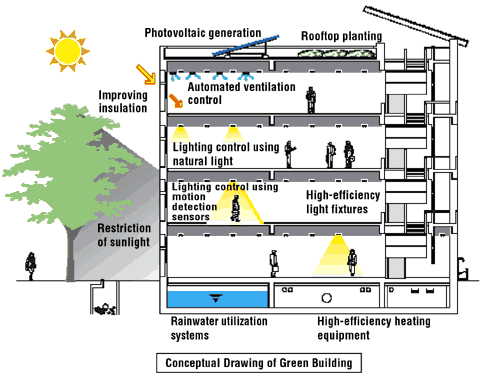
Structured Products Extra News Alert
Structured Products Extra News Alert: "May 1 2009
Comment from the Editor:
The tacit acceptance that the Lehman Brothers Minibond debacle was the root cause of all of Asia’s problems with structured products belies the fact that the rot had already set in well before, at least for the region’s private bankers. They had lost money far earlier than the losses inflicted by Lehman’s demise, on target redemption notes, power reverse dual coupon notes, and especially accumulators.
In 2007, accumulators were the best bet in town for private bankers in Asia, and they basically meant that you made money almost on a whim. Then the market turned sour in the early months of 2008 and everyone in accumulators suddenly rushed to leave as the value of their investments plummeted. The damage was so profound in Hong Kong that it inspired a novella entitled, ‘I Kill You Later’, a neat phonetic interpretation of the word accumulator.
Then the damage that Lehman and its Minibonds inflicted in Asia soon overshadowed the furore surrounding accumulator losses.
But now they’re back, or at least the conditions under which accumulators may look like quite a good investment option are back. If you can find a private banker in Asia who is not still reeling from the erosion of the wealth experienced by his clients, then you could entice him back with the future profits that look to be on offer.
Just in case you have tried to expunge all thoughts of accumulators from your memory, this, neatly encapsulated in a research piece published this week by JP Morgan, is what you could be missing out on: An accumulator is a costless product that enables investors to gradually build a long stock position at a fixed discount to the current spot price, provided the underlying trades below a pre-agreed barrier. Therefore, as the amount of stocks accumulated increases, upside exposure becomes uncapped. This differentiates accumulators from pure short put positions which in the best-case scenario only generate a fixed premium known upfront. Additionally, whereas a short put is settled on a particular day at expiry, an accumulator provides a sort of averaging of the final expiry level.
Richard Jory
Editor, Structured Products
richard.jory@incisivemedia.com
+44 (0)20 7484 9802"
Comment from the Editor:
The tacit acceptance that the Lehman Brothers Minibond debacle was the root cause of all of Asia’s problems with structured products belies the fact that the rot had already set in well before, at least for the region’s private bankers. They had lost money far earlier than the losses inflicted by Lehman’s demise, on target redemption notes, power reverse dual coupon notes, and especially accumulators.
In 2007, accumulators were the best bet in town for private bankers in Asia, and they basically meant that you made money almost on a whim. Then the market turned sour in the early months of 2008 and everyone in accumulators suddenly rushed to leave as the value of their investments plummeted. The damage was so profound in Hong Kong that it inspired a novella entitled, ‘I Kill You Later’, a neat phonetic interpretation of the word accumulator.
Then the damage that Lehman and its Minibonds inflicted in Asia soon overshadowed the furore surrounding accumulator losses.
But now they’re back, or at least the conditions under which accumulators may look like quite a good investment option are back. If you can find a private banker in Asia who is not still reeling from the erosion of the wealth experienced by his clients, then you could entice him back with the future profits that look to be on offer.
Just in case you have tried to expunge all thoughts of accumulators from your memory, this, neatly encapsulated in a research piece published this week by JP Morgan, is what you could be missing out on: An accumulator is a costless product that enables investors to gradually build a long stock position at a fixed discount to the current spot price, provided the underlying trades below a pre-agreed barrier. Therefore, as the amount of stocks accumulated increases, upside exposure becomes uncapped. This differentiates accumulators from pure short put positions which in the best-case scenario only generate a fixed premium known upfront. Additionally, whereas a short put is settled on a particular day at expiry, an accumulator provides a sort of averaging of the final expiry level.
Richard Jory
Editor, Structured Products
richard.jory@incisivemedia.com
+44 (0)20 7484 9802"
Chinese company to finance $300 million in U.S. wind farms | Green Business | Reuters
Chinese company to finance $300 million in U.S. wind farms | Green Business | Reuters:
"NEW YORK (Reuters) - Private U.S. company Tang Energy Group said on Friday a Chinese company has agreed to provide $300 million in financing for its wind power projects.
'It's very helpful for us in this time of tight credit,' said Patrick Jenevein, president of Tang. He said the financing was a 'huge boost' that would help the company build some 200 to 250 megawatts of wind power capacity, enough to power about 75,000 homes with electricity.
The CATIC International Trade and Economic Development Ltd, a subsidiary of the state-owned industrial group the China Aviation Industry Corp, agreed to provide the financing to Dallas-based Tang.
Jenevein said the turbines financed by the agreement will be built of materials that are at least 40 percent U.S.-made. The towers and blades are likely to be U.S.-made while the cells of the turbine are likely to be made in China.
Over the past several years, Chinese investment companies have been minority investors in such U.S. power projects such as natural gas-fired power plants and transmission lines.
Tang is considering wind farm projects in Illinois, Texas, Colorado, Iowa, Virginia and Massachusetts.
(Reporting by Timothy Gardner; Editing by David Gregorio)"
"NEW YORK (Reuters) - Private U.S. company Tang Energy Group said on Friday a Chinese company has agreed to provide $300 million in financing for its wind power projects.
'It's very helpful for us in this time of tight credit,' said Patrick Jenevein, president of Tang. He said the financing was a 'huge boost' that would help the company build some 200 to 250 megawatts of wind power capacity, enough to power about 75,000 homes with electricity.
The CATIC International Trade and Economic Development Ltd, a subsidiary of the state-owned industrial group the China Aviation Industry Corp, agreed to provide the financing to Dallas-based Tang.
Jenevein said the turbines financed by the agreement will be built of materials that are at least 40 percent U.S.-made. The towers and blades are likely to be U.S.-made while the cells of the turbine are likely to be made in China.
Over the past several years, Chinese investment companies have been minority investors in such U.S. power projects such as natural gas-fired power plants and transmission lines.
Tang is considering wind farm projects in Illinois, Texas, Colorado, Iowa, Virginia and Massachusetts.
(Reporting by Timothy Gardner; Editing by David Gregorio)"
Asian nations set up $120 billion crisis fund | Reuters
Asian nations set up $120 billion crisis fund | Reuters: "By Yoo Choonsik
NUSA DUA, Indonesia (Reuters) - Thirteen East and Southeast Asian countries agreed Sunday to set up an emergency $120 billion fund to provide liquidity to any of them in need of help during the economic downturn.
Japan also unveiled a scheme to supply up to 6 trillion yen ($61.54 billion) to support nations hit by economic crisis.
The moves, announced on the sidelines of the Asian Development Bank's annual meeting on the Indonesian island of Bali, could lead to some optimism in regional markets on Monday, one analyst said.
'This news is not a surprise but confirmation may be taken by the optimists as a reason to continue the recent rally,' said Kirby Daley, senior strategist at Newedge Group in Hong Kong."
NUSA DUA, Indonesia (Reuters) - Thirteen East and Southeast Asian countries agreed Sunday to set up an emergency $120 billion fund to provide liquidity to any of them in need of help during the economic downturn.
Japan also unveiled a scheme to supply up to 6 trillion yen ($61.54 billion) to support nations hit by economic crisis.
The moves, announced on the sidelines of the Asian Development Bank's annual meeting on the Indonesian island of Bali, could lead to some optimism in regional markets on Monday, one analyst said.
'This news is not a surprise but confirmation may be taken by the optimists as a reason to continue the recent rally,' said Kirby Daley, senior strategist at Newedge Group in Hong Kong."
Subscribe to:
Posts (Atom)